
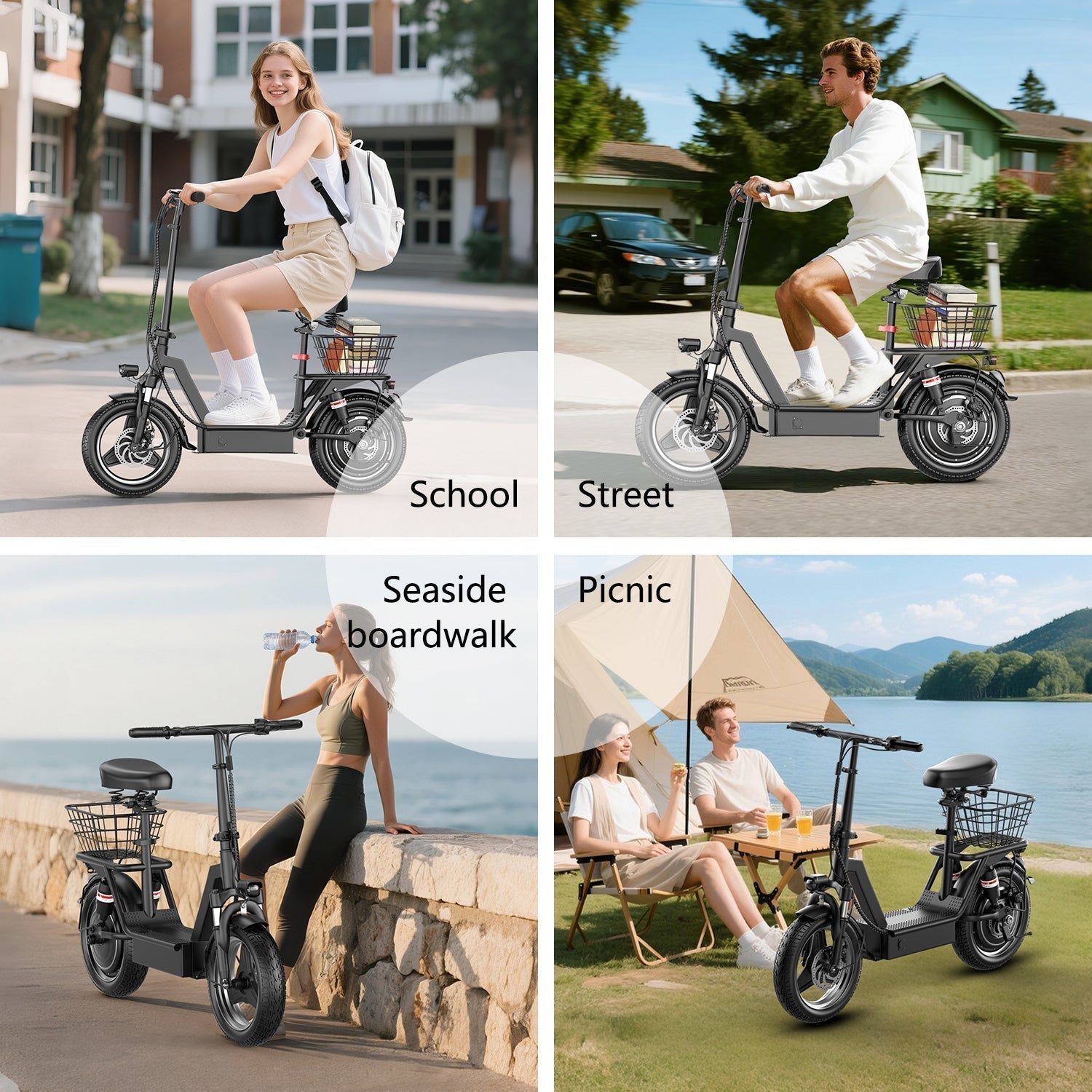
Most people, guides, and spec sheets give the wrong advice when choosing an electric scooter. More watts, more speed, more advertised miles must mean a better scooter, right? Not necessarily.
The right scooter is not necessarily the fastest or the one with the longest advertised range. It’s the one that handles your everyday route the best.
Whether you’re riding to work, scooting around town, or just enjoying a leisurely ride, each scooter is designed for a specific rider. The secret is finding the one that works for you.
This electric scooter buying guide will help you choose an e-scooter based on the journeys you make, the surfaces you ride on, and the practical features that will matter every time you leave home.
Quick Answer: How to Choose an Electric Scooter
The hunt for the right electric scooter begins and ends with your normal route. Understand what kind of challenges you face, and you can pick a scooter with the right set of features.
Start by answering these five questions:
1. Where do you ride each day?
2. Is the journey bumpy and rugged or smooth and even?
3. How much payload do you carry (including yourself)?
4. How far do you need to go? And how often can you recharge?
5. What are the local laws and safety regulations in your area?
Between those five questions, you can determine whether you need to focus on great suspension, fat tires, excellent range, or just a lightweight city cruiser.
Here’s how that works in practice:
|
Riding priority |
Look for |
Be prepared to compromise on |
Best-suited scooter type |
|
Short daily commute |
Portability, reliable brakes, manageable weight |
Extreme range and speed |
Commuter scooter |
|
Seated comfort |
Seat quality, deck space, larger tires |
Portability |
Seated electric scooter |
|
Lower budget |
Reliable core components and warranty |
Premium suspension and added features |
Budget scooter |
|
Longer journeys |
Battery capacity, ride comfort, charging time |
Weight and price |
Long-range scooter |
|
Hills and heavier loads |
Nominal motor power, torque, brakes |
Weight and battery consumption |
Performance scooter |
|
Mixed or uneven surfaces |
Wider tires, suspension, ground clearance |
Compactness |
All-terrain or off-road scooter |
Start With the Ride You’ll Actually Make
Browsing e-scooters without knowing your stuff, and it’s easy to get drawn in by the big numbers. Most companies put their impressive specs front and center. (We’re no exception.)
The question isn’t whether you should have a scooter with good specs; it’s what specs matter most for your journey.
For example, if you’re riding under 10 miles per day, battery capacity and range are unlikely to be a major factor. Nor is suspension or fat tires a concern if you’re only riding on smooth city roads. That said, it could be more important if you want greater comfort or you’re carrying heavier loads.
Whenever a customer asks us which scooter to go for, we get them to describe their route. Riders choosing primarily for work travel should also use our guide to the best electric scooter for commuting. It can actually help to drive along it. You’ll notice things you never spotted before.
Use this decision matrix:
|
Ask yourself |
Why it matters |
Specifications to examine |
|
How far is my usual round trip? |
Determines the minimum practical range |
Battery Wh, tested range, charging time |
|
How much do I weigh with my belongings? |
Affects speed, range, braking and hill performance |
Maximum payload, nominal motor power |
|
What are the roads or paths like? |
Determines comfort, grip and puncture risk |
Tire type, tire width, suspension |
|
Will I carry or store the scooter indoors? |
Heavy scooters can become impractical surprisingly quickly |
Scooter weight, folded dimensions |
|
Are there steep or prolonged hills? |
Hill climbing requires more than a high top speed |
Torque, nominal power, voltage, controller |
|
Do I prefer standing or seated riding? |
Changes the required frame, deck and ergonomics |
Seat design, deck size, handlebar height |
Electric Scooter Specs Explained in Plain English
Watt-hours. Maximum payload. IP rating. Most electric scooter specs may as well be written in German for how easy they are to understand. You might be familiar with the terms, but what do they mean in practice?
- Voltage (V): The electrical potential of the battery system, which influences how power is delivered.
- Amp-hours (Ah): How much charge the battery holds.
- Watt-hours (Wh): Overall battery capacity and the best figure for comparing potential range.
- Nominal watts: The motor’s sustained everyday power.
- Peak watts: The motor’s maximum power in short bursts.
- Maximum payload: The total rider and luggage weight supported.
- Tire size: Affects comfort, stability, and handling.
- Suspension: Absorbs bumps and rough surfaces.
- Charging time: How long a full recharge takes.
- Scooter weight: How practical it is to carry and store.
- IP rating: The level of tested water and dust resistance.
How Much Electric Scooter Range Do You Really Need?
Range is how far your scooter will go on a single charge. The listed range is usually based on optimum conditions, e.g., a flat, even surface, medium rider weight, and a steady riding speed.
The range is determined primarily by the battery capacity. Just like a car, however, the battery will drain faster the more demand you place on it. Hills, high speeds, or heavier loads will lower the range. Even riding against the wind can make a difference.
Scooters with fat tires or low tire pressure will also have a lower range — although many models compensate with a larger battery capacity.
It’s sensible to use your normal riding journey as a benchmark for range. Select an electric scooter with a comfortable margin rather than choosing a scooter whose claimed maximum only just covers the intended journey (including the full round trip). For a more realistic way to calculate daily mileage, read our electric scooter range guide, which explains usable range, rider weight, hills, and weather.
Remember, batteries will decline with age, and you might not always have somewhere to charge. That’s why a little extra power is so important.
Battery Specs That Actually Tell You Something
Batteries are one of the areas where customers get the most confused. The terms aren’t as common in everyday usage as those for gas engines.
Let’s break down what everything means:
Voltage, Amp-Hours and Watt-Hours
Voltage describes the power system, whereas amp-hours indicate capacity within that system. If those numbers still feel abstract, our electric scooter battery guide explains voltage, amp-hours, watt-hours, charging, and battery lifespan in plain English. Some brands list the voltage and amp-hours together; others list watt-hours.
Watt-hours are calculated by multiplying the voltage by the amp-hours. For example, the GT28 Electric Scooter has a 48V 20Ah battery. That gives it a total capacity of 960Wh.
 Calculating the watt-hours can help. A larger Ah figure does not automatically mean a larger battery when two scooters use different voltages.
Charging, Storage and Battery Quality
Charging time isn’t always a big factor. You’ll want a scooter that can go from empty to charged in a reasonable amount of time.
Always use the charger supplied or approved by the manufacturer. Before buying, check that replacements are readily available, since using an incompatible charger can create a serious fire risk.
A few simple charging, storage, and sourcing habits can help keep your scooter’s battery safe and performing well for longer:
- Buy from a reputable seller and look for recognized certification such as UL 2272.
- Use only the battery and charger supplied or approved by the manufacturer.
- Charge while you are awake and nearby, then unplug when finished.
- Keep the battery between 20% and 80% where practical.
- Avoid storing it completely full or empty for long periods.
- Never use modified, damaged, or unverified replacement batteries.
Buy the Ride, Not the Top Speed
Top speed is one of the least useful specifications when considered alone. Most scooters are ridden in stop-start environments where maintaining maximum speed is neither practical nor efficient.
Nominal motor power shows what the motor can sustain, while peak power is available for brief acceleration and short inclines. Dual motors can improve acceleration and hill climbing by driving both wheels.
Real-world performance also depends on rider weight, torque, battery voltage and controller tuning. Long hills require sustained power, not simply an impressive peak figure.
More power usually means greater weight, cost and energy consumption. Choose enough for your route and load, rather than paying for speed you are unlikely to use.
Note: Some top speeds aren’t legal in all jurisdictions. Always check your local laws before purchasing an electric scooter.
Tires, Suspension, and Ride Comfort
Tires and suspension are where much of a scooter’s comfort comes from. Use the electric scooter tire guide to compare solid, pneumatic, and fat tires before deciding which ride quality and maintenance trade-off suits you. The right setup cushions gravel, cracked roads, and uneven tracks before every bump reaches your hands and feet.
There are four common tire options:
|
Tire type |
Main advantage |
Main drawback |
Best for |
|
Solid |
Cannot be punctured |
Firm ride and reduced grip on poor surfaces |
Smooth urban routes |
|
Pneumatic with inner tube |
Comfortable and widely repairable |
Vulnerable to punctures |
General commuting |
|
Tubeless pneumatic |
Comfort with better puncture resistance |
More complicated repairs |
Frequent adult riding |
|
Wide or fat tires |
Stability and cushioning |
Added weight and rolling resistance |
Mixed or uneven terrain |
Larger tires roll over cracks and potholes more easily, while wider tires improve stability on loose or uneven surfaces. However, the added weight and rolling resistance can reduce range.
Suspension becomes particularly useful when tires alone cannot soften the route. The K10 Electric Scooter, for example, combines 14-inch air-filled tires with dual shock suspension for urban and suburban riding.

Brakes and Safety Features
Brakes aren’t a headline feature for most electric scooters. Yet, in urban environments, stop-start riding means the brakes get a lot of work.
You’ll find a range of different braking types:
- Mechanical disc brakes: A cable squeezes pads against a disc. They stop well and are easy to repair but need occasional adjustment.
- Hydraulic disc brakes: Brake fluid provides smoother, stronger stopping with less effort. Our electric scooter brakes guide compares disc, drum, electronic, regenerative, and dual-brake systems in more detail. They suit faster scooters but cost more to maintain.
- Drum brakes: The mechanism sits inside the wheel, protected from dirt and damage. They need little maintenance but offer less stopping power.
- Electronic brakes: Motor resistance slows the scooter. They reduce wear but work best alongside a physical brake.
- Regenerative brakes: Electronic brakes that return a small amount of energy to the battery while slowing down.
- Combined or dual brakes: Brake both wheels or combine systems for better control and added backup.
Electronic brakes work best alongside a physical brake because they rely on the motor, controller and battery. Mechanical, hydraulic or drum brakes provide independent friction braking for more dependable stopping.
Other features like headlights, rear lights, reflectors, turn signals, and a horn or bell are vital for safety. While you might not need turn signals, having lights and reflectors means cars and pedestrians can see you at night. Plus, depending on the model type, some jurisdictions may legally require these features.
A Folding Scooter Is Not Always a Portable Scooter
To most riders, portability is synonymous with a folding scooter. That’s not always the case, however.
Most e-scooters can be folded for storage or transport. That’s handy if you live in a small apartment or want to put the scooter in your car’s trunk.
However, just because a scooter folds doesn’t mean it’s light enough to carry over long distances, up stairs, or on public transport. Some models are also awkward or poorly balanced when lifted.
For example, the GT28 Electric Scooter looks more compact and portable than the K10 Electric Scooter when folded. Yet it weighs 82 lbs, almost twice the K10’s 45 lbs. Folded size matters, but weight and balance determine whether you’ll actually want to carry it.
Make Sure the Scooter Fits Your Body
The maximum payload is a safety limit, not a target to aim for. Your weight includes anything you carry, from a backpack to a full basket of shopping.
As the load increases, acceleration and hill climbing can suffer. Braking distances may grow, range can fall, and the motor, tires and frame all work harder. Leaving some breathing room below the stated limit is generally sensible.
Physical fit matters too.
The handlebars should be high enough for a relaxed posture, with every control comfortably within reach. Check that the deck is long and wide enough for your natural stance. Nobody wants to commute while folded up like a deck chair.
On seated models, look for adjustable seat height and somewhere comfortable to place your feet. Taller riders should pay particular attention to handlebar and seat adjustment.
Water Resistant Is Not Waterproof
Most brands don’t explain the IP rating. It refers to how wet the scooter can get before it stops working safely.
The most relevant IP ratings are:
- IPX4: Protected against splashing water.
- IPX5: Protected against low-pressure water jets.
- IP54: Protected against limited dust and splashing water.
- IP55: Protected against limited dust and water jets.
- IP56: Protected against limited dust and stronger water jets.
- IP66: Dust-tight and protected against powerful water jets.
- IP67: Dust-tight and protected during brief, shallow immersion.
Just because a scooter has a high IP rating doesn’t automatically make it suitable for heavy rain, deep puddles, or water immersion. Before riding in rain or storing a scooter outdoors, check what its rating actually permits in our guide to electric scooter waterproofing and water resistance. Nor does it have any impact on tire grip. Regardless of the IP rating, it’s best to avoid too much water, as it can enter charging ports and damage the scooter.
If the scooter gets wet, leave it to dry indoors after use.
Check the Brand as Carefully as the Scooter
Brands matter, just not in the way you think.
We’re usually drawn to the biggest brands in any sector. Name recognition implies at least some level of quality. However, riders often end up paying much more than they need to for a mid-quality scooter.
Instead, look at the brand’s reputation, owner feedback, and their policies (specifically warranty and returns policy). You also want to check the availability of spare parts. Sooner or later, you’ll need to replace brake pads, tires, or some other component. Your scooter will last a lot longer if you can replace those parts.
Check Local Laws Before You Click Buy
In the US, e-scooter rules are mainly set at state and local level, so where and how you can ride varies considerably.
Electric scooter laws can change across state and city lines. In California, riders need a license or permit, cannot exceed 15 mph, and cannot ride on sidewalks. Helmets are mandatory for riders under 18. In New York City, riders must be at least 16, cannot exceed 15 mph, and can use bike lanes or streets with speed limits no higher than 30 mph, but not sidewalks.
Before buying, confirm local rules covering:
- Road, bike-lane and sidewalk use
- Speed and motor-power limits
- Age and helmet requirements
- Licensing, registration and insurance
- Trails, parks and public transport
Check official state, municipal, and transit-agency websites for further guidance. Because speed limits, sidewalk rules, and registration requirements vary, review the current overview of electric scooter laws in the US, Canada, and Europe.
How Much Should You Spend on an Electric Scooter?
Budget is usually the main constraining factor determining which electric scooter you buy. That’s not a bad thing. Your budget is often a measure of how important an electric scooter is to your life. The best budget is determined by frequency of use, route difficulty, and required comfort rather than arbitrary specifications.
Here’s how to use your budget best:
|
Budget |
What buyers should prioritize |
|
Under $600 |
Reliable brakes, sound battery construction, basic comfort and support |
|
$600–$1,000 |
Stronger commuter features, improved range and better ride quality |
|
$1,000–$1,500 |
Larger batteries, more capable suspension and stronger hill performance |
|
$1,500+ |
Specialist range, performance, terrain capability or premium comfort |
Focusing on the brand might mean you pay more. But it’s no guarantee of quality. A cheaper scooter from a lesser-known brand might give you more features, greater support, and a more reliable ride than an unusually powerful model with weak support.
There Is No Single “Best Electric Scooter for Adults”
For Everyday Commuting and Affordable Comfort
Comfort, range, and braking become a lot more important when you’re riding the scooter day after day. If rider size, comfort, payload, and stability are your main concerns, see how we evaluate the best electric scooters for adults. If you’ve got a short journey, you might be happy to stand. But for most people, having a seat is less of a luxury and more of a necessity.
The K10 14” Electric Scooter is a great option for commuters. Lightweight, foldable, and suitable for riding on the roads, it has a dual suspension system and bigger wheels for that added comfort. It even comes with a rear basket for storing your belongings.
For Longer Rides, Hills and Higher Performance
If you’re dealing with longer rides and bigger hills, focus on sustained motor power, torque and battery capacity. Check the nominal rather than peak motor figure, and choose a claimed range comfortably above your full return journey.
The GT28 Electric Scooter uses a 3,000W peak dual-motor system, reaches up to 35 mph and offers up to 70 miles of claimed range under ideal conditions. Its 82 lb weight is the main trade-off.
For Cautious First-Time Riders
Your first scooter doesn’t need to break any records.
Look for predictable acceleration, stable tires, reliable brakes, and controls that feel straightforward from the first ride. Good lights and a manageable weight are also crucial — far more than flashy extras.
It’s sensible to give the scooter a quick try around your local area before heading onto busy roads. Practice starting, turning, and braking somewhere quiet.
The 60-Second Check Before You Buy
You don’t have to evaluate every single electric scooter on the market rigorously. Most people browse around a dozen and pick the best of the bunch.
- Here are a few questions to ask for each scooter:
- Does the realistic range cover my full return journey?
- Is the payload suitable for me and anything I carry?
- Are the tires right for my usual surfaces?
- Does it have effective mechanical brakes?
- Can I comfortably lift and store it?
- Is the riding position suitable for my height?
- Are replacement parts and support available?
- Can I legally use it where I intend to ride?
Depending on your requirements, you won’t need to ask every question every time. Always base your evaluation on your route, your payload, and how often you’ll use the scooter.
Electric Scooter Buying Guide FAQs
What Should I Look for When Buying an Electric Scooter?
The main factors to look for are battery range, battery quality, motor power, brakes, tires, and payload. It really depends on how you intend to use the scooter.
If you’re tackling hills or rough terrain, motor power, suspension, and tires matter most, whereas if you’re focused on long-distance commutes, battery range, payload, and comfort are the biggest considerations.
How Much Electric Scooter Range Do I Really Need?
More than you think. Most listed ranges are under optimum conditions. Pick a range that’s bigger than your normal journey. That gives you some comfort room, ensuring you can get from A to B without draining the battery.
Is a 500W, 1000W or Dual-Motor Scooter Better?
Think about where you’ll ride. A 500W scooter is usually plenty for flat commutes and lighter riders. Move up to 1000W if you’re heavier, want quicker acceleration, or regularly face hills.
Dual motors make sense for steep climbs and demanding routes, but add weight, cost, and battery drain. Check whether figures are nominal or peak before comparing models.
Are Electric Scooters Safe for Adults?
Absolutely. Electric scooters are a safe, convenient, and easy-to-use way for adults to commute, travel around town, or enjoy a leisurely ride.
Should I Choose Solid or Pneumatic Tires?
Solid tires reduce the risk of punctures. But they’re heavier, less comfortable, and generally provide less grip. Pneumatic tires are the traditional option, giving you greater grip and comfort.
Is It Better to Buy an Electric Scooter With a Seat?
That depends. For older adults, longer commutes, or just people who prefer sitting, it’s a good option. The downside is added weight and portability issues.
How Much Should I Spend on an Electric Scooter?
You can get a good electric scooter anywhere between $500 and $1,500. You should only pay more if you’re after a specific feature, like a bigger motor or larger range. Otherwise, for most people, an e-scooter around that price will be good enough.
Find the Scooter That Fits the Way You Ride
Buying an electric scooter gets much easier once you stop looking for the “best” model and start looking for the right one. The fastest scooter might be too heavy to carry. The lightest might struggle on hills. And the longest advertised range means little if the ride leaves your teeth rattling.
Start with the journeys you actually make. Check the distance, hills and road surfaces, then think about your weight, storage space and preferred riding position. From there, the useful specifications become much easier to spot.
Compare PostJoy electric scooters to find the right balance of comfort, range and power for the way you ride.
Share:
Best Electric Scooter Under $600
Best Electric Scooter for Commuting: What to Look For Before You Buy