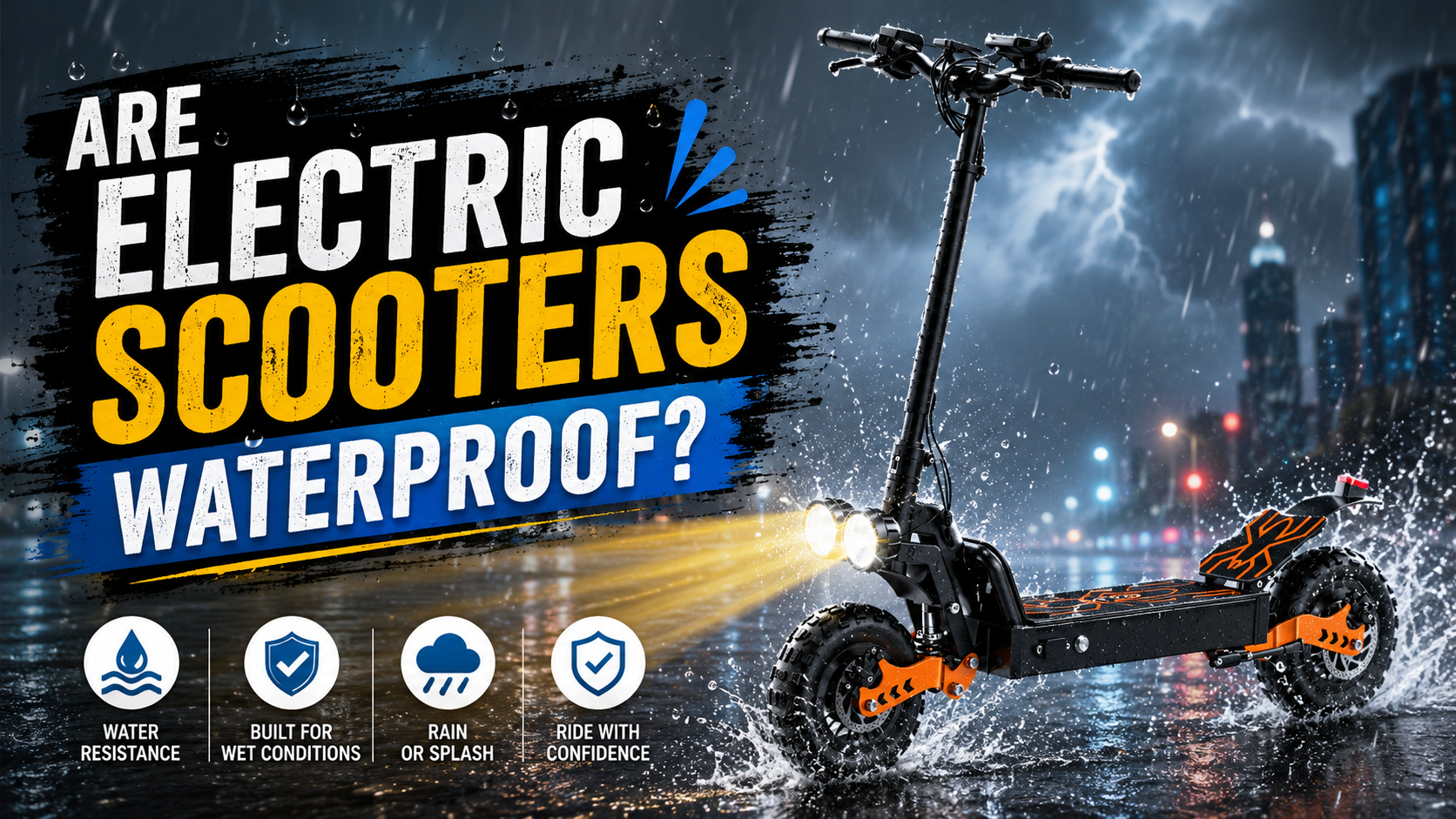
The short answer is no, most electric scooters are not fully waterproof. But that doesn't mean you can't ride one in the rain. Most modern electric scooters are water-resistant to varying degrees, and understanding the difference between waterproof and water-resistant is important for riding safely and protecting your scooter from damage.
The waterproof question comes up a lot, especially from commuters who want to use their scooter every day and can't always plan around the weather. The good news is that most quality electric scooters can handle the light to moderate rain that you're likely to encounter. But that is provided you ride sensibly and take care of the scooter properly. The bad news is that many riders push it further than they should, end up with water damage that voids their warranty, and have to pay more to repair it than the scooter is worth.
This guide covers what water resistance means for electric scooters, how to read IP ratings, what you can and can't do in wet conditions, how to protect your scooter, and which PostJoy models are built to handle everyday weather.

Waterproof vs. Water-Resistant: What's the Difference?
These two terms are not the same, and you need to know the difference when you're deciding to ride in wet conditions.
A waterproof device can be fully submerged in water without damage. No electric scooter on the consumer market is truly waterproof in this sense. If you ride through a deep puddle and your scooter goes underwater, the electronics will be damaged. Some manufacturers use the word “waterproof” loosely in their marketing, but it's worth looking past the language and checking the actual IP rating, which gives you a specific and standardized measure of protection.
A water-resistant device can take splashes, light rain, and surface moisture without damage, but it has limits. Most electric scooters fall into this category. They can handle riding through light rain or wet roads, but sustained exposure to heavy rain, riding through standing water, or pressure washing will cause problems.
The main difference is that water-resistant means your scooter can handle everyday wet conditions if you're sensible and don't take it too far. It does not mean you can ride through floods, leave it out in a downpour, or clean it with a hose. Knowing where your scooter sits on that spectrum is what helps you ride confidently without taking risks that could lead to expensive damage.
What Is an IP Rating?
IP stands for Ingress Protection. IP protection is one of several specifications worth checking in the electric scooter buying guide. It's a standardized rating system that tells you exactly how well a device protects against solid particles and liquids. You'll see it written as a two-digit code, like IP54 or IP67.
The first digit indicates protection against solids, such as dust, on a scale of 0 to 6. The second digit indicates protection against water on a scale of 0 to 9. The higher the number, the greater the device's protection. An X in place of either digit means the rating hasn't been tested for that category; for example, IPX5 means it's been tested for water resistance but not dust resistance.
For electric scooters, the water protection rating is the most important. Here's what the common ratings mean in practice:
IPX4 means the scooter can handle splashing water from any direction. This is adequate for light rain and wet roads, but not for heavy rain or riding through puddles. Many entry-level and mid-range scooters sit at this level.
IPX5 means the scooter can handle water jets from any direction. This gives you more confidence in moderate rain, but it is still not suitable for sustained downpours or standing water. This is probably the most common rating of quality consumer scooters.
IPX6 means the scooter can handle powerful water jets. This is the kind of rating that gives you real weather protection for heavier riding conditions, and is worth looking for if you live somewhere with frequent rain.
IPX7 means the scooter can be submerged in up to one meter of water for up to 30 minutes. Very few consumer scooters reach this level, and for most riders, it's more protection than they'll ever need.
Most electric scooters on the market have ratings between IP54 and IP56, which cover everyday riding in light to moderate rain. If a scooter has no IP rating at all, treat it as having minimal water resistance and avoid riding it in wet conditions entirely.
Can You Ride an Electric Scooter in the Rain?
Yes, but how safely you can do it depends on your scooter's IP rating and how you ride.
Light drizzle and damp roads are fine for any scooter with an IP54 rating or above. The main thing you have to remember is to slow down a little and give yourself more room to brake. Wet roads reduce your stopping distance even on a scooter that feels completely stable, so it's worth building that habit before you need it.
Moderate rain is manageable on IP55 or higher. But you need to reduce your speed, keep your turns wide, and give yourself significantly more braking distance than you would on a dry day. Disc brakes are better than drum or rim brakes in the wet, so it's worth knowing what your scooter has before you're relying on it to stop quickly in the rain.
Heavy rain is a different story. Even a well-rated scooter can be overwhelmed by a sustained downpour. Water finds its way into connections and seams that handle light rain without any problem. Add reduced visibility for other road users and a wet road under your tires, and the risk goes up considerably. In heavy rain, the right call is to stop and wait it out.
There are conditions you should avoid regardless of your scooter's IP rating. Don't ride through standing water or puddles deeper than a couple of inches. Don't ride in flooding conditions. And don't pressure wash your scooter, even if it has a solid IP rating. The pressure forces water past seals that are made to handle rainfall, not a directed jet. Apply those limits with the wet-weather techniques in how to ride an electric scooter safely.
Tires and Braking in Wet Conditions
Your IP rating tells you how well the electronics handle moisture. But the two things that most affect how safely you can ride in the rain are tires and brakes, and neither of those has anything to do with IP ratings.
Pneumatic tires grip wet roads better than solid rubber because they deform slightly under load and maintain better contact with the surface. Solid tires don't do this, and they feel noticeably more slippery when you're riding on wet roads. If you regularly commute in the rain, a scooter with pneumatic tires is the better choice. A wider tire also helps, as it has more contact with the road, meaning more traction, which is part of why fat tire scooters feel more planted in wet conditions. The electric scooter tire guide explains how tread, tire pressure, and pneumatic construction affect traction.
When it comes to brakes, disc brakes give you better stopping power than drum or rim brakes in wet conditions. Review brake types and maintenance in the electric scooter brakes guide, especially if wet-weather riding is unavoidable. Hydraulic disc brakes are the best kind as they are more consistent and require less hand force than mechanical ones. They are also easier to modulate, which means you have more control in slippery conditions.
One thing that often gets forgotten is road surface. Wet tarmac is slippery, but there are even more slippery parts of the road that can catch you out. For example, painted road markings, metal drain covers, tram tracks, and wet leaves can cause you to lose traction when you least expect it, when it's raining. On a dry day, you barely notice them. On a wet day, hitting one while turning or braking is how most scooter falls happen. It's incredibly important to slow down before you ride over any of these, not while you're on them.
The thing you really need to take away from this is to brake earlier than you think you need to, keep your speed down, avoid sharp turns, and watch the road surface ahead of you, not just the traffic.
What Happens If Your Scooter Gets Too Wet?
The battery, motor, and controller are the most sensitive parts of your scooter. If water gets into any of them, the damage can be serious. In some cases, it's not fixable without a full component replacement.
You may see signs of water damage, including the scooter not turning on after a wet ride, erratic display or control behavior, a drop in range that doesn't recover after charging, or unusual smells near the battery. Sometimes these signs don't show up straight away. Corrosion builds slowly and causes failures that seem to come out of nowhere weeks later. That's why drying the scooter after every wet ride is important, even when it seems fine after the ride itself.
If you think water has gotten into your scooter's electrical system, don't turn it on. Let it dry in a warm, ventilated area for at least 24 to 48 hours. Also, don't charge it while it might still be wet inside. A short circuit from a wet battery can be dangerous. If the battery has had significant water exposure, get it checked by a technician before riding again.
Repairs range from cheap to very expensive. A display or controller might be a straightforward fix, but battery damage often means a full replacement, which can cost nearly as much as the scooter. One of the most common causes of avoidable battery damage is riders who try to charge a wet scooter the same evening because they need it for the morning commute. The 24 to 48-hour wait feels inconvenient, but it's considerably less inconvenient than replacing a battery.
How to Protect Your Scooter in Wet Conditions
There are a few ways you can protect your scooter when you need to ride in wet conditions. The first thing you can do is apply silicone sealant to cable connections and seams. Doing this adds a little more protection to the IP rating. Many experienced riders apply it when they first get the scooter. They concentrate on the charging port and any connection points where water is most likely to enter. It takes about ten minutes and costs almost nothing.
The charging port is worth paying particular attention to. Most are not well sealed, and water entering the socket causes serious problems. If your scooter doesn't come with a port cover, an aftermarket rubber cap is cheap and effective. Check it's properly covered before every wet ride, and you might want to keep a spare in your bag if you commute in variable weather.
Once you get home from a wet ride, make sure you wipe the scooter down. Concentrate on the deck, handlebars, stem, folding joints, and visible connections. A two-minute wipe with a dry cloth prevents problems that could appear weeks later. If there's water sitting in a fold or joint, work it out with the cloth.
Don't leave the scooter outside in wet weather if you can avoid it. Even a good IP rating won't stop seals from degrading from weeks of sustained moisture exposure. If you need to leave it outside, buy a fitted waterproof cover. These are not expensive, and they extend the scooter's life considerably more than most riders expect.
PostJoy Electric Scooters and Wet-Weather Riding
PostJoy's electric scooter range is built for daily use in real conditions.
 The PostJoy GT28 is a great option for riders who want performance in all weather. The 3000W peak dual-motor system gives strong, consistent power on wet and uneven roads, and the NFC unlocking means you're not fumbling with a key or app in the rain. The 11x2.5-inch fat tires give considerably more grip in wet conditions than standard narrow tires, and the front and rear shock suspension keeps the ride stable on rough or slippery surfaces.
This scooter also has dual disc brakes, giving reliable stopping power, which is important when you consider the higher speeds this scooter can reach. With a 48V 20Ah battery and 40 to 70 miles of range, it's ideal for riders who are out in all conditions and need a scooter that doesn't make wet weather a concern.
 The PostJoy K10 is the more practical everyday option. At $399.99, the 1000W peak motor, 48V 13Ah battery, and up to 35 miles of range cover most typical commutes without issue. The 14x2.2-inch pneumatic tires and dual suspension give a comfortable and stable feel on wet urban roads, and the foldable frame makes it easy to bring indoors when the weather turns, which is always the better option if you have the choice. The seat and rear basket make it one of the most practical scooters at this price, and the lighter weight makes it easy to carry up stairs or onto public transport.
Final Thoughts
Most electric scooters handle everyday wet conditions well if you treat them right. The damage usually isn't from riding in the rain. It's from riding through deep puddles, leaving the scooter outside for days in wet weather, or trying to charge it when it's not fully dry.
Get a scooter with an IP54 rating or higher, know your brakes, and bring it inside when you're not riding it. That covers most of what you need. The rest is just riding sensibly and giving yourself more time and space to stop than you would on a dry day.
If you're buying a new scooter specifically for wet-weather commuting, look for pneumatic tires, disc brakes, and an IP55 rating or above. Those three things together give you a considerably safer and more reliable experience in the rain than a cheaper scooter with no IP rating and solid tires.
Browse the full PostJoy electric scooter range to find the right model for your commute and conditions. PostJoy also has a range of electric bikes if a pedal-assisted ride suits you better.
FAQ
Are electric scooters waterproof?
No. Most are water-resistant, not waterproof. They handle light to moderate rain and wet roads, but should not be submerged or ridden through deep standing water.
What IP rating should I look for?
IP54 or higher for light rain. IP55 for moderate rain. For regular wet-weather riding, IP56 or higher is worth considering.
Can I ride my electric scooter in the rain?
Yes, with care. Slow down, increase your braking distance, and avoid heavy downpours and deep puddles. Dry the scooter when you're done.
What should I do if my scooter gets wet?
Let it dry in a warm, ventilated space for at least 24 to 48 hours before turning it on. Don't charge it until you're sure it's dry inside.
Will riding in the rain void my warranty?
It depends on the manufacturer. Most warranties don't cover water damage, even on water-resistant models. Some manufacturers will cover damage if your scooter has an IP rating and you were riding in conditions consistent with that rating, but this isn't universal. Check the terms before making wet-weather riding a regular habit, and keep a record of your scooter's IP rating in case you ever need to make a claim.
Can I wash my electric scooter with a hose?
No. Even scooters with solid IP ratings aren't designed for directed water pressure. Wipe down with a damp cloth instead.
Share:
Are Electric Dirt Bikes Legal?
Are Electric Scooters Safe?