
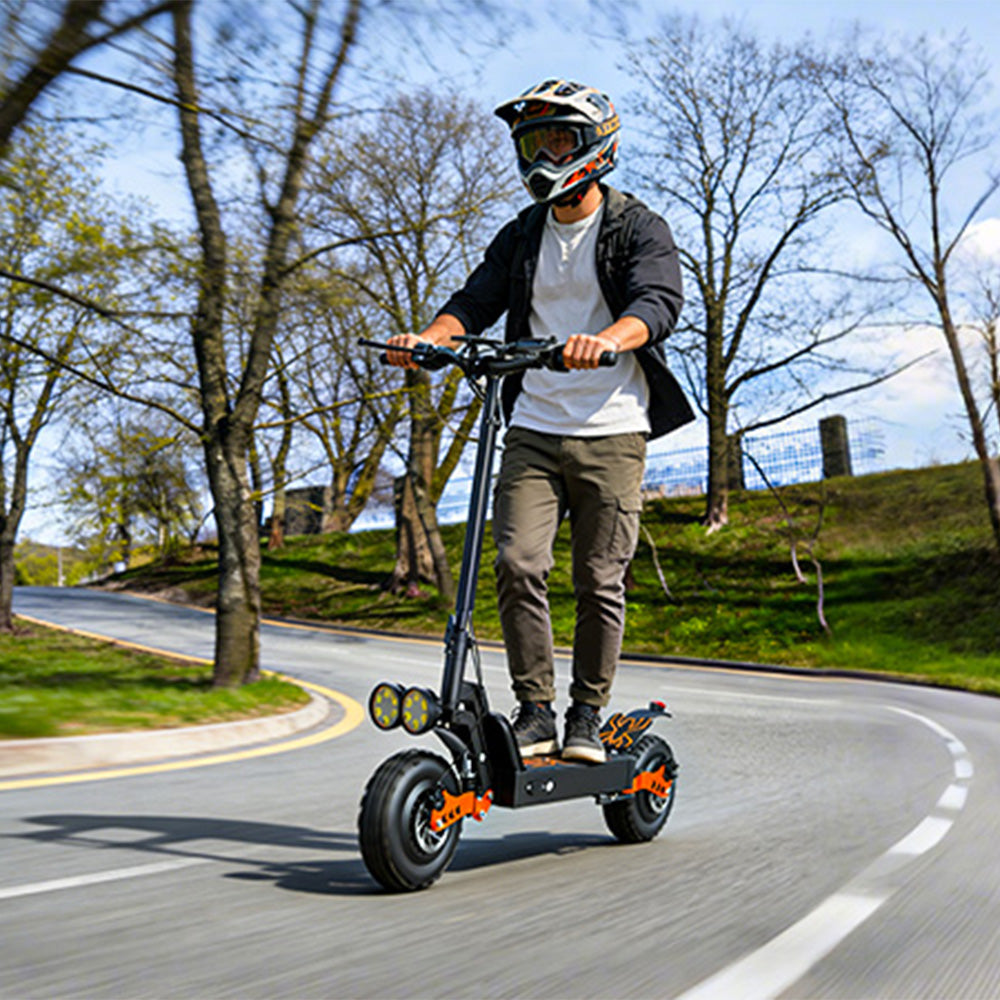
You don’t always need a car or e-bike to commute. An electric scooter is nimble, compact and well suited to the stop-start reality of urban and suburban riding. The right commuter scooter simply needs to handle your route reliably, day after day.
That route might be three miles through busy streets, nine miles over hills and broken roads, or split between home, the train and your workplace.
Each journey demands something different. This guide will help you find the best electric scooter for commuting based on the route you actually travel, not the most impressive headline specification.
What Makes a Good Commuter Electric Scooter?
A good commuter electric scooter is the one optimized for your route. If you are still comparing scooter categories and specifications, use the electric scooter buying checklist before narrowing the choice to commuter models. It should have enough range for the return journey (plus capacity to spare — you don’t want to be stranded by the roadside). It needs comfortable tires, reliable brakes, and enough power for any challenging terrain, without adding unnecessary weight.
Most brands don’t advertise these features. They’re focused on power, top speed, or exceptional range. That all matters. But it just might not matter for you.
Selecting the best e-scooter for commuting begins and ends with your route. If you’re only riding a few miles on flat urban streets, too much power or a really high speed is a liability, not an advantage. The opposite is true if you’re traveling from the suburbs.
First Mile, Last Mile, or the Whole Commute?
When will you use your electric scooter?
Scooters are a popular option for first and last mile journeys. Commuters have to hop on and off public transport and get home as quickly as possible. But they don’t want the bulk or weight of a portable e-bike. The priority here is low weight and compactness.
By contrast, a whole commute leans towards comfort, range, braking, and weather protection. It’s the primary means of transport and needs to reflect that.
Here’s a quick breakdown:
|
Commute type |
Prioritize |
Likely compromise |
|
First or last mile |
Low weight, compact folding and quick setup |
Range and suspension |
|
Full work commute |
Range, braking, lights and comfort |
Carryability |
|
Campus or local errands |
Easy handling, storage and security |
High performance |
|
Suburban or mixed roads |
Larger tires, suspension and battery margin |
Weight |
|
Hilly commute |
Sustained motor power, torque and strong brakes |
Price and energy consumption |
How Much Range Does Your Commute Really Need?
Let’s say your office is 5 miles from your home. You plan to complete the entire commute on your scooter. So, you need a range of 10 miles to get from A to B and then B to A. (Learn how to add a practical reserve for hills, weather, and battery aging in our guide to real-world electric scooter range.)
Well, not quite.
First, most advertised electric scooter ranges are based on optimum conditions. It doesn’t include a heavier load (e.g., work bags), hills, higher rider weight, increased speed, wind, or stop-start practice.
You also don’t want a scooter with the precise range of your journey. Having a few miles extra gives you some comfort room. Opting for something with a lot more range means you don’t have to charge it every night, increasing the longevity of the battery.
For a 10-mile journey, therefore, a smart choice would be something in the 20-mile range. Battery quality can decline with age. So, you’ll also be covered far into the future.
Fast Enough Is Better Than Fastest
Unless you’ve got a ‘need for speed,’ how fast a scooter can go usually isn’t the deciding factor. Around 15-25 mph is sufficient for most commutes.
In fact, with stop-start riding due to traffic lights, crossing, corners, and congestion, acceleration is a much more important factor than another five mph on the spec sheet.
Faster scooters also require stronger brakes, better tires, greater rider judgment, and more protective equipment. They are usually heavier and consume more battery.
The final factor is the law. Some electric scooters might have a top speed higher than the legal limit on roads. Electric scooters aren’t governed by the three-class system used for electric bikes. However, if the scooter has too much power, it can fall under moped or motor-driven-cycle laws, depending on the jurisdiction.
Choose Tires and Suspension for the Road You Use
Your commute may look smooth on Google Maps. In reality, city roads are full of potholes, paving seams, drain covers, loose gravel, and wet leaves. The wrong tires make every one of them noticeable.
- Small solid tires: Light and impossible to puncture, but firm and unforgiving on broken pavement.
- Pneumatic tires: Air-filled for better cushioning and grip, with the usual risk of punctures.
- Tubeless pneumatic tires: Comfortable and generally more puncture-resistant, although roadside repairs are trickier.
- Larger or wider tires: Better at rolling over cracks, drains and uneven surfaces, but heavier.
The electric scooter tire guide helps match solid, pneumatic, or fat tires to smooth streets, potholes, and mixed surfaces.
Suspension isn’t essential on every commuter scooter. Good air-filled tires can absorb many smaller bumps on their own. Over longer distances, however, constant vibration quickly becomes tiring. Suspension helps soften those repeated impacts.
That’s why the K10 Electric Scooter combines 14-inch air-filled tires with dual-shock suspension, making longer urban and suburban journeys considerably more comfortable.

Don’t Treat Brakes and Lights as Extras
Brakes and lights are rarely headline features. For stopping-system differences and pre-ride checks, read the electric scooter brakes guide. Most people might not even check the spec sheet to see if they’re any good — if only because they don’t understand what’s listed.
Good brakes and lights aren’t optional extras, however. They’re essential to your safety, even if you don’t ride regularly at night or at high speeds.
Strong mechanical braking or a dual-brake setup is recommended for heavier riders, faster scooters, or hilly routes. Electric braking is excellent, but it should always be a support system, not the only form of braking.
Built-in lights are partly about being seen, not simply lighting the road ahead. Riders commuting in winter, early mornings or poor weather should pay particular attention to visibility.
Will You Have to Carry It?
Foldable and portable aren’t the same thing.
A foldable electric scooter might be designed to fit snugly inside your car’s trunk or in the corner of your city apartment. It’s a scooter for vacations, not necessarily a city commute. The problem is usually that it weighs too much.
Most electric scooters are foldable. The real consideration is where you’ll need to carry it. If it’s a short trip in your office, weight isn’t much of an issue. If you’re walking up and down stairs, getting on or off public transport, or carrying it for any length of time, even a seemingly lightweight scooter can become an issue.
Use the simple rule: if you carry it every day, weight matters enormously. If you rarely lift it, a heavier scooter may give you a much better ride.
|
Your daily routine |
What matters most |
|
Carrying it upstairs or onto a train |
Low weight and compact folding |
|
Rolling it into an elevator or office |
Ride comfort may matter more than weight |
|
Lifting it into a car trunk |
Folded size, weight and lifting points |
|
Storing it in a garage |
Range, tires and suspension can take priority |
Make Sure It Works at Work
Imagine you’ve bought a new e-scooter for commuting. It’s lightweight, has the perfect range, and is generally ideal for your commute. But then you get to work, and there’s nowhere to store it. It simply can’t be folded without blocking corridors.
You’ve got a major problem you didn’t think about in advance.
Ask yourself these questions:
- Is there somewhere secure to store it?
- Can it be folded without blocking corridors?
- Are scooters or lithium batteries permitted inside?
- Is charging available and allowed? (Check how long an electric scooter takes to charge before relying on a partial charge during the workday.)
- Do you need to carry a lock?
- Where will wet clothing or equipment go?
- Can you bring the scooter onto connecting public transport?
- Are sidewalks around the workplace legal to ride on?
If in doubt, talk to your employer. They can explain where you can store the scooter securely and if there are any special rules you need to know about.
Which PostJoy Scooter Fits Your Commute?
|
Commuter need |
Useful features |
PostJoy scooter |
|
Seated daily comfort |
Adjustable seat, larger tires, suspension and storage |
K10 |
|
Short-to-mid work commute |
Manageable weight, folding and dependable range |
K10 |
|
Longer or hillier route |
Larger battery, dual motors and stronger performance |
GT28 |
|
Higher-speed commuting where legal |
Brakes, stability and sustained power |
GT28 |
K10 for Comfortable Everyday Commuting
The K10 Electric Scooter is designed as a comfortable, everyday rider. Equipped with a seat, rear basket, and a dual-shock suspension system, it’s the best option for getting to school, work, or just enjoying a gentle weekend ride.
The larger tires, suspension, and rear basket also mean it’s optimized for heavier payloads. It has a payload capacity of 300 lbs.
Perfect for shorter-to-mid-distance commuting and regular errands.
The detailed K10 vs GT28 electric scooter comparison shows which model fits flat urban trips and which better handles hills and longer routes.
GT28 for Longer and Hillier Routes
The GT28 Electric Scooter might lack a seat. However, it has much more power and range. With a 3,000W peak dual-motor system, a top speed of 35 mph, and up to 70 miles in range, it’s optimized for longer, more challenging journeys.

The powerful dual motor system is ideal for tackling steep hills or uneven ground. So if your commute involves the local park or a troubling section of road, the GT28 will handle it with ease.
The only downside is the weight. At 82 lbs, it’s less suitable for stairs or frequent public transport.
Commuter Electric Scooter Buying Checklist
Before buying, picture an ordinary commute on a cold, wet Tuesday:
- Will the battery get you there and back without relying on workplace charging?
- Can it handle the steepest hill and roughest section of your route?
- How far will you actually need to carry it?
- Where will you store, charge and lock it at work?
- Can you legally ride it across every part of the journey?
- Will your train or bus operator let you bring it aboard?
- Are replacement tires, brake pads and chargers easy to find?
If any answer is unclear, resolve it before ordering. A scooter that looks perfect online can become irritating remarkably quickly when it meets stairs, rain, and an overcrowded train.
Commuter Electric Scooter FAQs
Is an Electric Scooter Good for Commuting?
They’re a great option for shorter urban journeys, predictable routes, and transit connections. For longer journeys or difficult terrain, an e-bike might be preferable.
How Far Can I Commute on an Electric Scooter?
That depends on the range of the scooter. Most people find journeys up to 10 miles comfortable on a scooter, although ranges can reach as high as 70 miles.
What Speed Is Best for Commuting?
Speeds between 15 and 25 mph, where permitted are enough for most routes. However, stops and infrastructure mean most riders rarely hit the scooter’s top speed.
Should a Commuter Scooter Have Suspension?
If you’re only riding on flat urban roads, pneumatic tires are enough. For rough roads or longer journeys, suspension is worthwhile. It can help absorb the tiring road vibrations.
Can I Bring an Electric Scooter on Public Transport?
It depends on the operator, so check its rules before traveling. The rules usually refer to folded dimensions, peak travel periods, and lithium batteries.
Is a Seated Scooter Good for Commuting?
For older riders, carrying belongings, or greater stability, many riders prefer a seat. However, it adds to the weight and reduces portability.
Choose for the Commute You Actually Have
The best commuter scooter is the one you stop thinking about after the first week. It starts each morning, gets you to work without a nervous battery calculation, and fits into the rest of your day without becoming an unwelcome piece of furniture beside your desk.
Forget about selecting the scooter based on headline specs. Focus exclusively on what will make your daily ride more comfortable, more convenient, or more manageable.
Compare PostJoy electric scooters and find the model built for your daily commute.
Share:
Electric Scooter Buying Guide: How to Choose the Right e-Scooter
Best Electric Scooter for Adults: Speed, Range, Comfort, and Safety Compared