Both the PostJoy K10 and GT28 are good scooters. But they're built for very different riders, and choosing the wrong one means you will end up with features you don't need or a scooter that doesn't suit your needs.
This guide breaks down the differences so you can choose the perfect one for you.

Quick Verdict
If you want to sit down on your commute, the K10 is the one to go for. It's the only seated scooter in the PostJoy range; it's $200 cheaper than the GT28, and it covers the needs for most everyday urban riders.
If you need to define your priorities before comparing these two models, use the electric scooter buying guide.
If your commute has hills, you need more range, or you want more power, the GT28 is worth the extra cost. The dual-motor system puts it in a different performance category from almost everything else at this price.
|
What you need |
Choose |
Why |
|
Seated comfort for daily commuting |
K10 |
Adjustable padded seat, lower speed, practical price |
|
More range and longer rides |
GT28 |
Up to 70 miles vs 35 miles |
|
Hill climbing and heavier riders |
GT28 |
3000W dual motors, 30° uphill, higher payload |
|
Budget-focused practical commuter |
K10 |
$399.99, rear basket, removable battery |
|
Off-road or mixed terrain capability |
GT28 |
11-inch off-road tires, stronger motor |
|
Seated option specifically |
K10 |
GT28 has no seat |
Side-by-Side Specs
|
Spec |
K10 |
GT28 |
|
Price |
$399.99 |
$599.99 |
|
Motor |
1000W peak |
3000W peak dual motors |
|
Top speed |
25 mph |
35 mph |
|
Battery |
48V 13Ah |
48V 20Ah (960Wh) |
|
Range (claimed) |
Up to 35 miles |
Up to 70 miles |
|
Payload |
300 lbs |
Verify live |
|
Tires |
14x2.2" pneumatic |
11" off-road pneumatic |
|
Brakes |
Disc brakes |
Dual disc brakes |
|
Suspension |
Dual suspension |
Front and rear shock |
|
Seat |
Yes, adjustable padded |
No |
|
Folding |
Yes |
Yes |
|
Charging time |
~6 hours |
Verify live |
|
Rear basket |
Yes |
No |
Riding Style and Comfort
The biggest difference between these two scooters isn't the motor; it's the seat.
Standing on a deck for 30 minutes every morning can get tiring, especially if you have to travel far. The K10 lets you sit down, making daily commuting more comfortable. Riders who want a deeper comfort comparison can read the guide to choosing an electric scooter with a seat. But you can also ride it standing up if you prefer, as the deck is wide enough for both. The 14x2.2-inch pneumatic tires and dual suspension take the edge off potholes and rough surfaces, which most standing scooters at this price don't.
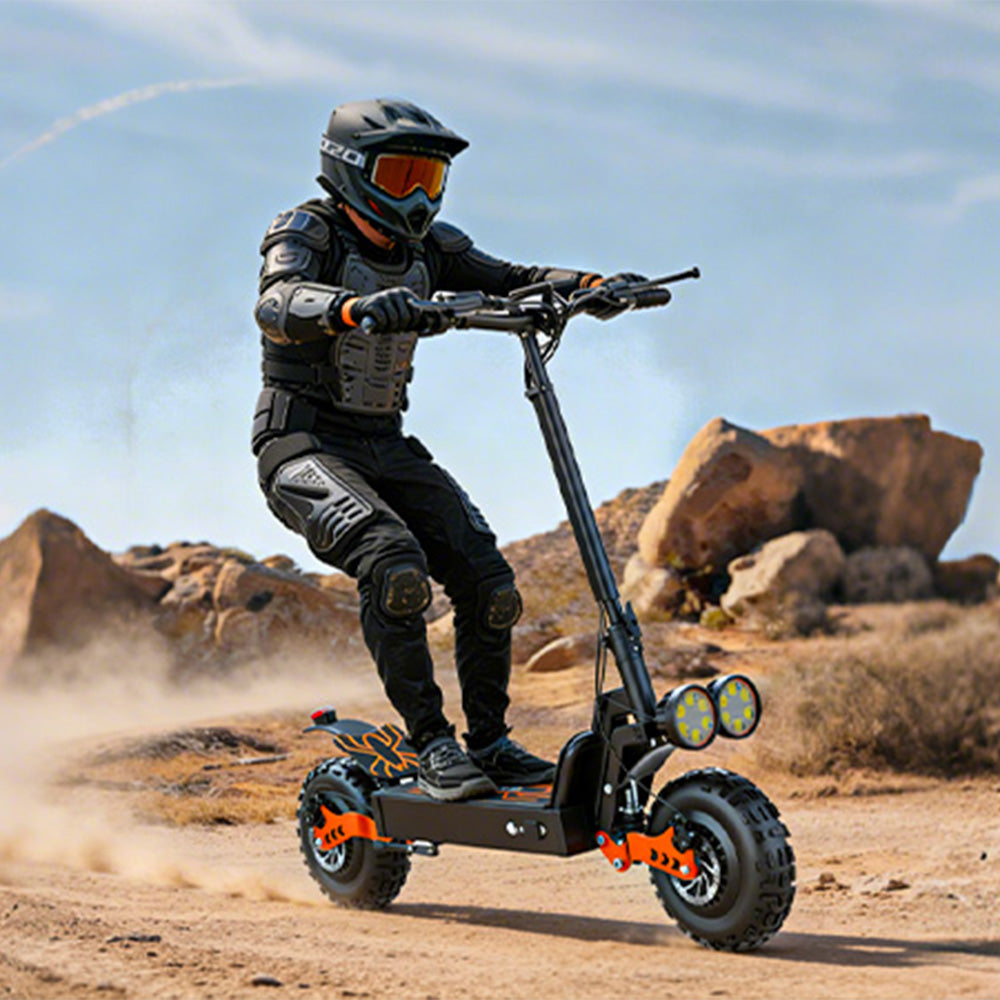
You don't get a seat with the GT28. But it does have 11-inch off-road pneumatic tires, and front and rear suspension, which give you a stable ride even at 35 mph. This electric scooter is built for riders who are comfortable standing and want more capability, but don't consider a high level of comfort as a main priority.
Range, Battery, and Charging
PostJoy claims up to 35 miles for the K10. You may not get that in real-world conditions, as riding uphill, carrying a backpack, or doing lots of stop-start riding in a city can use more battery power. So most people can expect 20-25 miles, which is enough for a 10-mile round trip. The electric scooter range guide explains why both models may travel less than their advertised maximums. It's worth knowing that the battery is removable, so you can charge it at your desk without bringing the whole scooter inside.
For voltage, Ah, Wh, battery life, and charging care, see the electric scooter battery guide. Check the charging formula and practical schedules in how long it takes to charge an electric scooter.
The GT28 is powered by a 48V 20Ah (960Wh) battery, which can deliver up to 70 miles in ideal conditions. In practice, you'll probably get around 40 to 45 miles, which is still enough for a couple of days of commuting on a single charge, or a longer weekend ride without having to worry about range too much.
If your round-trip commute is under 20 miles and you have somewhere to charge at home, the K10 is ideal. But if you ride longer routes, the GT28's larger battery justifies its extra cost.
Speed, Power, and Hills
For flat urban roads, the K10's 1000W motor at 25 mph is more than enough for most daily commutes. Riders prioritizing speed and climbing can explore the wider high-performance electric scooter guide.
It's when you add hills, a heavier rider, or cargo that the GT28 starts to pull away. The 3000W dual-motor system delivers 75Nm of torque and can handle up to 30-degree inclines comfortably. This is a very different proposition entirely from what a single 1000W motor can manage when the road gets steep. If steep hills are a regular part of your route, you'll certainly notice the difference between the two.
When it comes to speed, it's best to check your local e-scooter regulations before riding either model on public roads. At 25 mph, the K10 is legal in most US states, but the 35 mph top speed of the GT28 may be treated differently depending on where you are.
Portability, Storage, and Daily Practicality
Both scooters fold, but living with them day to day is a different experience.
The K10 is lighter and more compact, and has a removable battery so you can charge it at your desk without dragging the whole scooter inside. Unlike the GT28, it also has a rear basket that's great for carrying groceries and bags. If you have to carry the scooter upstairs, onto a bus, or store it in a small flat, the K10 is easier to deal with due to its lightness.
Carrying the GT28 up three flights of stairs every day isn't something most people would want to do. The dual-motor system and 11-inch tires add bulk, and while it fits in most car trunks when folded, it takes more effort to handle when you're not riding it than the K10. But if your storage is straightforward and you don't need to carry it much, the extra weight is a fair trade for the performance you get.
Safety and Braking
At 25 mph, the K10's disc brakes do a good job. The electric scooter brakes guide explains how speed and scooter weight change braking requirements. But the GT28's dual-disc brakes are designed to match the 35 mph top speed. They need a bit more maintenance, but it's nothing too involved. You just need to check the pads and rotors every few months if you're regularly riding at speed.
No matter which scooter you ride, you should always wear a helmet. Also, use lights when visibility is low, and ease off in wet conditions. The pneumatic tires on both models grip better than solid tires in the wet, but avoid deep standing water.
Who Should Not Buy Each Model
The K10 isn't the right scooter if your commute includes steep hills, you regularly carry heavy loads, or you need more than 25 miles of real-world range per day. But it gives you comfortable urban commuting at a fair price.
As for the GT28, it‘s heavier and bulkier than the K10. So it's worth thinking about if easy storage and portability matter a lot to you. Budget is another thing; at $599.99, it's not the cheapest option, and the 35 mph speed means you'll need to be more aware of local regulations than you would on the K10.
Which PostJoy Scooter Should You Choose?
Most urban riders with a flat, round-trip commute under 25 miles will find that the K10 at $399.99 covers everything they need. Adult riders comparing payload, comfort, speed, and stability may also use the guide to the best electric scooter for adults. The seat, rear basket, and removable battery make it a more practical daily tool, and there's not much reason to spend more if that's your situation.
If your route has hills, you're covering longer distances, you carry more weight, or you just want the most capable scooter in the range, the GT28 at $599.99 is hard to beat for the money.
Still not sure? Think about how you'll use the scooter most days. If it's a straightforward urban commute with a fixed route, the K10 will serve you well and leave $200 in your pocket. If your route varies, includes any real elevation, or you want a scooter that can do more at weekends, the GT28 is the one worth stretching to.
Browse the full PostJoy electric scooter range to compare both.
FAQ
Is the PostJoy K10 or GT28 better for commuting? The K10 is the best commuter for most people. So, if your commute is flat, under 25 miles round trip, and you want to sit down, it covers everything you need. But if your route has hills or you need more range, the GT28 is the better option.
Which has a longer range, K10 or GT28? The GT28 by a long way. In practice, expect around 20 to 25 miles from the K10 and 40 to 45 miles from the GT28, even though the claimed figures are 35 and 70 miles respectively.
Which PostJoy scooter is better for hills? The GT28. A single 1000W motor on the K10 will struggle on steep inclines, especially with a heavier rider. The GT28's 3000W dual-motor system with 75Nm of torque handles up to 30-degree climbs.
Which is better for heavier riders? The GT28, thanks to its dual-motor output and larger 11-inch tires. Check the current product page for confirmed payload capacity before buying.
Is the K10 easier to store than the GT28? Yes. It's lighter, folds more compactly, and since the battery is removable, you can charge it separately without bringing the whole scooter inside.
Which scooter should beginners choose? The K10 is the better starting point. The lower top speed, the option to sit, and the lighter weight all make it easier to get used to. Standing at 35 mph on the GT28 takes a bit more confidence.
Share:
Electric Scooter Battery Guide: Voltage, Ah, Wh, Charging, and Battery Life
How Long Does It Take to Charge an Electric Scooter?