The best electric dirt bike for beginners is the one you can fit, control, stop, recover, charge, and legally ride. Not the fastest. Not the one with the biggest motor. The one where you can dab both feet flat when stopped, reach the brake levers without overstretching, and pick the bike up after you tip it over. Because you will tip it over. That's riding. The goal is to learn control on a bike that won't punish every mistake, in a place where making mistakes is legal and safe.
Your first electric dirt bike should prioritize three things: fit (can you touch the ground and reach the controls?), controllability (does the throttle respond predictably, and can you stop when you need to?), and support (can you get parts, charge the battery safely, and find someone to help when something breaks?). Everything else is negotiable.
In This Guide
- What Makes a Bike Beginner-Friendly
- Follow the Power and Control Ladder
- Match Your First Bike to Rider and Terrain
- Check the Specifications
- Run the Fit Check
- Budget for Support and Gear
- Confirm Safety and Legal Riding
- Avoid Common Mistakes
- Score Your Shortlist
- FAQs
What Makes an Electric Dirt Bike Beginner-Friendly?
Beginner-friendly isn't about slapping an age sticker on a box. It's a system: the motor responds smoothly when you crack the throttle, the brakes give you feedback before they lock, the bike fits your body, and you can control it at walking speed without your heart rate spiking. You're looking for predictability, not peak performance.
Controllable Power Matters More Than Maximum Power
| What Looks Impressive on Paper | What Actually Helps a New Rider |
|---|---|
| 5500W peak motor | Low-power mode that caps output to something manageable |
| 28+ MPH top speed | Throttle map that doesn't dump torque the instant you twist |
| 70 Nm torque | Smooth, predictable engagement from zero |
| Multiple riding modes | An actual beginner mode you can lock in until you're ready |
A 5500W motor sounds aggressive, and it can be. But if that motor has selectable modes and the beginner setting caps output, limits top speed, and smooths the power curve, it's more beginner-friendly than a 2000W motor with instant, uncontrolled response. I'd rather have a powerful motor I can dial down than a weak motor I can't tune up later.
Controllable regenerative braking also helps. When you roll off the throttle, you want the bike to slow predictably, not coast forever or engine-brake hard enough to upset your balance.
Fit and Recoverability Matter More Than an Age Label
Can you:
- Touch both feet flat (or at least the balls of your feet) when sitting at a stop?
- Reach full steering lock without overstretching your arms or leaning into the bars?
- Pull the brake levers comfortably with two fingers while keeping your wrists neutral?
- Stand on the pegs in a balanced, slightly crouched position without feeling like you're about to tip forward or backward?
If yes to all four, the bike fits. If no to any, keep looking. No amount of "suitable for ages 13+" marketing changes the fact that you can't control a bike you can't reach.
And can you recover the bike? If it tips over on flat ground, can you lift it back up by yourself? Can you pivot it in a tight space? If not, that bike is too heavy or too awkward for you right now, no matter what the spec sheet says.
Follow the Beginner Power and Control Ladder
Learning to ride isn't about going fast. It's about controlling the bike at every speed, on every surface, with every distraction that real riding throws at you. This ladder gives you a structure. Pass each stage before moving up.
Stage 1: Low-Speed Starts, Stops, and Balance
| What You're Learning | What the Bike Should Have | Pass Condition |
|---|---|---|
| Smooth starts from a stop | Predictable initial throttle response | Five clean starts in a row, no jerking |
| Controlled stops without panic | Brake levers you can reach and modulate | Five controlled stops from 5-10 MPH |
| Low-speed balance and correction | Low seat height, manageable weight | Ride 50 feet in a straight line at walking speed |
| Emergency dismount | Geometry that lets you dab and step off | Stop, dab, dismount without falling |
You're looking for a bike with a true beginner mode that limits output, not just a sticker. Test in an empty parking lot or private property where you have space to make mistakes. Full protective gear: helmet, gloves, long sleeves, boots that cover your ankles.
Stage 2: Turns, Surface Changes, and Gentle Slopes
| Scenario | What You're Testing | Bike Traits That Help |
|---|---|---|
| Wide turns on hardpack | Weight transfer, throttle modulation | Predictable torque, good tire grip |
| Gravel or loose dirt | Traction loss, bike behavior when grip drops | Smooth power, not instant |
| Mild uphill (under 10 degrees) | Sustained power, balance under load | Motor torque curve, weight distribution |
| Mild downhill | Brake modulation, speed control | Progressive braking, regen if available |
The first time your front tire drifts in gravel, you'll understand why smooth power delivery matters. A motor that dumps full torque the instant you twist will spin the rear tire and scare you. A motor with a softer map gives you time to react.
Stage 3: Variable Terrain and Additional Power
You're ready for this stage when you can:
- Ride 15 minutes straight without mental fatigue or white-knuckling the bars
- Stop smoothly from any speed in your current riding mode
- Recover from a small traction loss without panic
- Correctly judge when a hill, turn, or surface is beyond your current skill
At this point, you can unlock higher power modes if the bike has them. Or stick with the mode you're comfortable in. Graduation isn't about speed. It's about consistent control and honest self-assessment.
You're not ready if you're still fighting the bike at low speeds, grabbing too much brake, or feeling surprised by what the throttle does.
Match Your First Bike to the Rider and Terrain
Adult Beginners With No Dirt Bike Experience
Priority order: fit, controllability, brakes, weight, support, then performance.
If you're coming from bicycles, you already understand balance and basic bike handling. But electric dirt bikes are heavier, faster, and respond differently than pedal bikes. The throttle is instant. There's no gradual ramp-up like pedaling. Respect that.
If you're coming from street motorcycles, you might have throttle control and braking experience, but dirt is different. Traction disappears. Sliding is normal. Your street instincts (counter-steering, leaning into turns) still apply, but the bike will move under you more than you're used to.
Either way, start with a bike that has adjustable power modes, hydraulic brakes, and a seat height that lets you dab confidently. For most adults, that means a seat height between 28 and 32 inches, but your inseam matters more than the number.
Open Practice Areas and Maintained Hardpack
| You Need | You Probably Don't Need (Yet) |
|---|---|
| Predictable throttle response | Extreme suspension travel |
| Reliable braking | Maximum claimed range |
| Local parts and service support | Aggressive trail tires |
| Stable, confidence-inspiring geometry | The lightest possible weight |
If you're learning on flat, open hardpack or gravel roads, you don't need a full-race suspension setup or 80 miles of range. You need a bike that responds the way you expect, stops when you pull the levers, and doesn't strand you with a dead battery or a broken part you can't source.

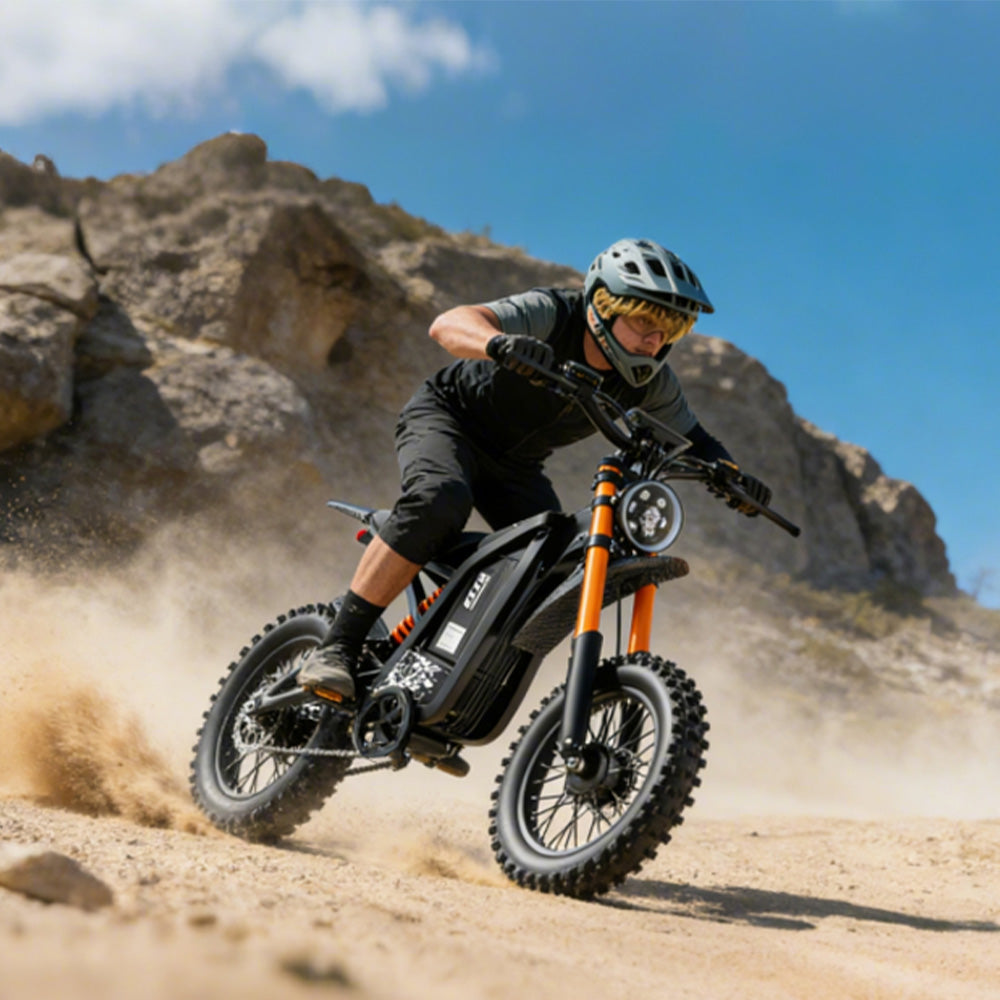
A bike like the PostJoy GT50 fits this profile. It's built for multiple surfaces (pavement, gravel, dirt), has hydraulic brakes, full suspension to smooth out the learning curve, and a 48V 25Ah battery that gives you plenty of practice time between charges. The 5500W peak motor sounds big, but the bike has selectable modes. In beginner mode, it's manageable. When you're ready, you can unlock more.
Progressing Toward Technical Trails
If your plan is to move from open practice areas to tighter, more technical trails (roots, rocks, tighter turns, steeper grades), look for:
- Suspension that can handle repeated hits. Full suspension helps, but cheap suspension that bottoms out or doesn't rebound properly is worse than no suspension.
- Enough range reserve. If the trail is 15 miles out, you need more than 30 miles of claimed range. Real-world range is always lower than the marketing number.
- Tires with actual tread. Smooth or semi-slick tires are fine for pavement and hardpack. On loose dirt, mud, or roots, you need something with bite.
- Protective features. Skid plates, reinforced frame, guards that keep branches out of the motor and controller.

The PostJoy GT16Plus steps up in a few ways: 16-inch off-road tires with aggressive tread, 60V 30Ah battery for more range, full suspension front and rear, and dual hydraulic brakes. It's still a beginner-capable bike if you keep it in low-power mode and respect your skill level, but it has room to grow with you. Recommended height range is 4'9" to 6', so it fits a wider variety of riders than many full-size dirt bikes.
If you'll split time between both: Start with the GT50 if most of your riding will be practice and occasional easy trails. Go with the GT16Plus if you plan to progress toward technical riding within six months. The GT16Plus handles practice areas fine but costs more and weighs more. Don't pay for capability you won't use for a year.
Don't overbuy. If you're not sure you'll ever ride technical trails, save your money. A simpler bike you can control beats a capable bike that intimidates you.
Check the Specifications That Affect a New Rider
Brakes, Suspension, Tires, and Controls
| Component | Beginner Benefit | Verification Question |
|---|---|---|
| Hydraulic disc brakes | Smooth, progressive stopping power; easier to modulate than mechanical | Are both brakes hydraulic, or just one? |
| Suspension (front and rear) | Absorbs bumps, keeps tires in contact with the ground, reduces fatigue | Is it adjustable? Can you get replacement parts? |
| Off-road tire tread | Grip on loose surfaces, predictable sliding | Are these actual dirt tires or street tires with marketing? |
| Brake lever reach | Controls you can actually reach and pull | Can you adjust the lever position? |
Hydraulic brakes give you more control than mechanical (cable-pull) brakes. You can squeeze gently and get gradual stopping force, which matters when you're learning to stop smoothly instead of locking the wheel.
Suspension quality varies wildly. Some budget bikes have suspension in name only: it compresses once, then stays there. Real suspension rebounds, absorbs repeated hits, and can be adjusted for rider weight. If you can't find adjustment info or replacement parts, assume it's basic.
Tires: look at the tread. If it looks like a street tire, it's a street tire. Actual off-road tires have deep, chunky lugs. The PostJoy GT50 and GT16Plus both use motorcycle-style off-road tires (20x3.0" and 16x3.0" respectively) with real tread. They'll work on pavement, but they're designed for dirt.
Battery, Usable Range, and Charging
Battery capacity comparison: The GT16Plus has a 60V 30Ah battery (1800Wh), while the GT50 has a 48V 25Ah battery (1200Wh). Think of it like fuel tank size: the GT16Plus stores 50% more energy, which translates to longer range or more reserve for hills and cold weather.
Three questions:
- What's the real-world range in beginner mode? Take the claimed max range, cut it by 30-40%. That's closer to reality. The PostJoy GT50 claims up to 80 miles. In beginner mode, on flat terrain, with a light rider, maybe you get 60-70. Add hills, higher speed, heavier rider, cold weather, and you're looking at 40-50. Plan accordingly.
- How long does it take to charge? Both PostJoy models take 6-8 hours for a full charge. If you're practicing for two hours in the morning, you can top off before an afternoon session. But if you drain the battery completely, you're done for the day.
- Can you charge it safely where you live? You need a standard outlet, a dry space, and the correct charger. Don't use an off-brand charger. Don't charge in the rain or in a damp garage. Don't leave it charging overnight on a wooden deck. Battery fires are rare, but they happen, and they're catastrophic.
The PostJoy models use removable batteries, which is good. You can charge the battery inside your house or apartment without bringing the entire bike in.
Weight, Payload, and Transport
Before you buy:
- Can you lift the bike? The GT50 weighs 93 lbs. The GT16Plus weighs 99.2 lbs. If you can't lift that, you can't recover it after a tip-over, and you can't load it into a truck by yourself.
- Does the bike support your weight plus gear? Both bikes have a 365 lb payload capacity. Count yourself, your gear, any cargo, and a safety margin. If you're 250 lbs with gear, you're fine. If you're 300 lbs, you're close to the limit, and the bike will feel sluggish.
- How will you transport it? These bikes don't fit in most car trunks. You need a truck, a trailer, or a hitch-mounted carrier rated for the weight.
Run the Five-Minute First-Bike Fit Check
This is a physical test. Do it before you buy, or within the return window if you're ordering online.
| Check | How to Test | Pass | Fail |
|---|---|---|---|
| Stable support (dabbing) | Sit on the bike, both feet on the ground. Can you touch flat-footed or at least on the balls of your feet? | Both feet touch with confidence | Tiptoeing, unstable, can't hold the bike upright |
| Full steering lock | Turn the bars all the way left, then right. Are your arms comfortable, or are you overstretching? | Comfortable reach at full lock | Overstretching, leaning into the bars |
| Brake and throttle reach | Can you pull the brake levers with two fingers while keeping your wrists neutral? | Easy reach, no wrist strain | Stretching, awkward hand position |
| Standing posture | Stand on the pegs, knees slightly bent, weight centered. Does it feel balanced? | Neutral, balanced, ready to move | Leaning forward or backward, awkward |
| Peg-to-seat space | From standing, can you sit back down smoothly, or is the seat in the way? | Smooth transition | Seat blocks movement |
| Dismount clearance | Stop the bike, dab your foot, swing your leg over. Is there enough clearance? | Easy dismount | Catching your leg on the seat or frame |
| Bike recovery | Tip the bike gently to one side (on soft ground), then lift it back upright. Can you do it? | Yes, with effort but doable | No, too heavy or awkward |
If you fail any of these, the bike doesn't fit. Don't buy it hoping you'll "get used to it." You won't. You'll build bad habits, lose confidence, and possibly get hurt.
The PostJoy GT50 is recommended for riders 5' to 6'3". The GT16Plus fits 4'9" to 6'. Those are guidelines, not guarantees. Your inseam and arm length matter more than your height. A 5'10" rider with a 30-inch inseam will fit differently than a 5'10" rider with a 32-inch inseam.
Budget for Support, Gear, and Growth
| Category | Required at Purchase | Likely Ownership Cost (1-2 years) | Optional Progression Cost |
|---|---|---|---|
| Protective gear | DOT helmet, gloves, boots, eye protection ($200-400) | Replacement gloves, helmet upgrade ($100-200) | Body armor, knee/elbow guards ($150-300) |
| Transport | Truck access, hitch carrier, or trailer ($200-800 if buying) | Ramps, tie-downs, maintenance ($50-100) | Enclosed trailer (if serious) |
| Charging | Proper outlet, dry space, manufacturer charger (included) | Electricity cost, spare charger ($50-150) | Fast charger, solar setup (if off-grid) |
| Wear parts | None (bike comes ready) | Tires, brake pads, chain/belt ($100-300) | Suspension service, upgraded tires ($200-400) |
| Battery planning | Included with bike | Battery capacity loss over time | Replacement battery ($300-800) |
The bike itself is just the start. If you skip the helmet because it's "just a parking lot," you're betting your skull against a 90-lb bike moving faster than you can run. Don't.
Total startup cost example: If you're buying a GT50 ($699) plus protective gear ($250), a hitch carrier ($300), and leaving $100 for the first year's maintenance, you're looking at $1,350 minimum to get started safely. Budget accordingly.
New vs. used: New gives you a warranty, known battery history, and support. The PostJoy bikes come with a 1-year warranty. Used saves money but comes with risk. You don't know how the previous owner charged the battery, stored the bike, or crashed it. If you buy used, pay for a professional inspection, especially of the battery and controller. A failing battery or damaged controller can cost more to replace than you saved buying used.
For a deeper cost breakdown, see the electric dirt bike cost guide.
Confirm Safety and a Legal Place to Learn
Green light (good to go):
- You have proper protective gear (at minimum: DOT helmet, gloves, boots, eye protection)
- You have a legal, controlled practice area (private property with permission, OHV park, designated riding area)
- The bike fits (passed the fit check above)
- The bike is in good condition (new, or used with verified inspection)
- You can charge the battery safely
Yellow light (get help first):
- You're not sure how to check the bike's condition
- You're unsure about charging safety
- You don't have riding instruction and want it
- The practice area is legal but you're alone with no emergency contact
Red light (stop, do not buy):
- You have no legal place to ride
- You don't have proper protective gear and can't afford it right now
- The bike doesn't fit (failed the fit check)
- The battery or electrical system shows damage (swelling, exposed wires, burnt smell, corrosion)
- You can't lift, control, or recover the bike
If you're not sure whether your local area allows electric dirt bikes, check your state's OHV (off-highway vehicle) regulations. Some states treat electric dirt bikes like bicycles. Others treat them like motorcycles and require registration, insurance, and a license. This varies by state and by bike specifications (power, speed, weight). For a detailed breakdown, see are electric dirt bikes legal.
Street-legal status: Both the PostJoy GT50 and GT16Plus are classified as off-road vehicles. Neither is street-legal in stock form without modification and registration. They're designed for private property, OHV parks, and designated off-road riding areas only.
Do not ride on public streets, sidewalks, or bike paths unless your bike is street-legal and you have the required license and registration. Do not ride on public trails unless they allow motorized vehicles. "I didn't know" is not a defense, and the fine is real.
Avoid These First Electric Dirt Bike Mistakes
- Buying for top speed instead of controllability. A 40 MPH bike that dumps power the instant you twist the throttle will hurt you. A 28 MPH bike with smooth, predictable delivery will teach you to ride. Later, when you have skills, you can upgrade. You can't upgrade your broken collarbone.
- Trusting age labels or marketing. "Suitable for ages 13+" tells you nothing about fit or skill. A 13-year-old who's 5'8" might fit. A 13-year-old who's 5'2" might not. Test the bike. If it doesn't fit, it's not suitable, regardless of the label.
- Skipping the fit test. You will crash. Everyone crashes. When you do, you need to be able to catch yourself, dab a foot, and recover the bike. If you're tiptoe-only at stops, you can't. Run the fit check before you commit.
- Believing maximum range claims. The number on the box is measured under perfect conditions: flat ground, low speed, light rider, no wind, warm temperature. Real-world range is 30-40% lower. Plan for that. If you need 30 miles of range, buy a bike that claims 50.
- Ignoring parts and service support. If you can't get brake pads, tires, or a replacement battery when you need them, the bike is disposable. PostJoy ships from US warehouses and offers a 1-year warranty. That matters. If your local bike shop won't touch electric bikes, find out before you buy, not after something breaks.
Score a Shortlist Without Inventing a Universal Winner
There is no single best beginner bike. The best bike for a 5'4" adult learning on flat pavement is not the best bike for a 6'1" adult planning to ride technical trails. Use this scorecard to compare your actual options.
Beginner Bike Scorecard (100 points total)
| Category | Weight | What You're Scoring |
|---|---|---|
| Rider fit | 25 pts | Passed fit check (dabbing, reach, standing posture, dismount, recovery)? Award points for how many checks passed. |
| Controllability | 20 pts | Does the bike have selectable power modes? Is beginner mode truly limited, or just labeled? Is the throttle response smooth or instant? Does regen braking work predictably? |
| Braking and chassis | 15 pts | Hydraulic brakes (both wheels)? Progressive feel? Suspension quality (adjustable, rebuildable, or basic)? Stable geometry? |
| Terrain fit | 15 pts | Do the tires, suspension, and ground clearance match where you'll actually ride? Street tires on a trail bike lose points. Trail setup for pavement-only use also loses points. |
| Usable range and charging | 10 pts | Real-world range (claim minus 30-40%) meets your needs? Charging time fits your schedule? Safe charging setup available? |
| Parts and warranty | 10 pts | Can you get replacement parts (tires, brake pads, battery)? Is there a warranty? How long, and what does it cover? |
| Transport and ownership | 5 pts | Can you lift the bike? Load it into your vehicle? Store and maintain it where you live? |
How to use this: Score each bike on your shortlist. Missing data gets marked "not verified," not an assumed midpoint. A 70+ is strong. A 60-69 is workable with tradeoffs. Below 60 means significant gaps.
Example (hypothetical):
- Bike A: Fits perfectly (25), has true beginner mode (18), hydraulic brakes and decent suspension (13), terrain match is good (14), range works (9), warranty and parts available (9), weight is manageable (4). Total: 92/100.
- Bike B: Fits okay but reach is awkward (18), no beginner mode, just one power level (8), mechanical front brake (10), tires are street-slick (8), range is fine (9), no warranty information (3), transport is difficult (2). Total: 58/100.
Bike A wins for this rider. Bike B might work for someone else with different priorities.
Who Should Not Buy This Bike Yet?
Mark any bike as disqualified if:
- You failed the fit check (can't dab, can't reach controls, can't recover the bike)
- The throttle response is uncontrolled in the lowest power setting (instant, jerky, unpredictable)
- You can't stop the bike smoothly and predictably
- You have no legal place to ride
- You don't have the budget for proper protective gear
- You don't have a safe place to charge the battery
- The battery or electrical system shows damage or the seller can't provide history
- The product specifications conflict between sources, and you can't verify which is correct
A high score doesn't override a disqualifier. If the bike fits great, has perfect controls, and scores 95/100, but you have no legal place to ride it, don't buy it.
Beginner Electric Dirt Bike FAQs
Are electric dirt bikes easier to learn than gas dirt bikes?
Yes, for most beginners. Electric dirt bikes skip the clutch and shifting, so you can focus on throttle, braking, and balance instead of managing a transmission. That's huge when you're new. The tradeoff: electric motors deliver full torque instantly, which can surprise you if the bike doesn't have a good beginner mode. And electric dirt bikes are often heavier than equivalent gas bikes because of the battery. Easier to operate, but not necessarily lighter or more forgiving if you dump too much throttle.
How fast should a beginner electric dirt bike go?
It's not about the number. It's about whether you can control the bike at every speed from zero to max. A bike that tops out at 20 MPH but has instant, jerky throttle response is harder to learn on than a bike that tops out at 35 MPH but has smooth, progressive delivery and a beginner mode that caps you at 15 until you're ready. Focus on controllability, not the top-speed spec. When you can start, stop, and turn smoothly in beginner mode, then you're ready for more speed.
Should a beginner buy a new or used electric dirt bike?
New if you can afford it. You get a warranty, known battery history, and support. Used saves money but adds risk. Batteries degrade with age and abuse (deep discharges, overcharging, temperature extremes, crashes). A used bike with a failing battery might cost more to fix than you saved buying it. If you go used, pay for a professional inspection, especially of the battery and controller. Ask for charge cycle history if the seller has it. If the bike has been crashed, walk away.
What safety gear does a beginner need?
Start with the non-negotiables: a DOT- or ECE-certified full-face or motocross helmet, gloves with palm and knuckle protection, boots that cover your ankles, and eye protection (goggles or a face shield). Long sleeves and pants, not shorts and a T-shirt. From there, add knee and elbow guards, a chest protector, and padded riding pants if you're learning on rough terrain or planning to progress to trails. Don't skip the helmet to save $100. Don't ride in sneakers because "it's just a parking lot." Parking lots are where a lot of beginners break ankles.
Quick Recommendations by Rider Profile
Not sure which bike to start with? Here's the short version:
Safety-first parent or adult (buying for teen or self): Start with the GT50 in beginner mode. Lock the power setting until Stage 2 skills are solid. The lighter weight (93 lbs) makes recovery easier, and the lower price lets you invest more in protective gear.
Adult beginner, practice areas only, no trail plans: GT50. You don't need the extra range or aggressive tires of the GT16Plus. Save $200+ and put it toward a quality helmet or a hitch carrier.
Adult beginner planning to progress to trails within 6 months: GT16Plus. The extra battery capacity, aggressive tread, and wider height range (4'9" to 6') make it worth the extra weight and cost if trail riding is your goal.
Budget-conscious first-timer: GT50 at $699 gives you the core features (hydraulic brakes, full suspension, selectable modes, removable battery) without paying for capabilities you might never use. Add protective gear and transport to your budget before committing.
Shorter riders (under 5'2") or taller riders (over 6'1"): GT16Plus fits 4'9" to 6'. GT50 fits 5' to 6'3". Run the fit check before ordering. Height ranges are guidelines, not guarantees.
Run the fit check. Score your shortlist. Then decide. If a bike doesn't fit or you have no legal place to ride, don't buy it, regardless of which profile matches.
Compare Verified Bikes Only After the Fit Check
Run the fit check first. Score your shortlist second. Then compare beginner electric dirt bikes with verified specifications.
The PostJoy GT50 and GT16Plus both fit the beginner-capable profile for the right rider: adjustable power, hydraulic brakes, real suspension, actual off-road tires, removable batteries, and US-based support. The GT50 is lighter (93 lbs vs. 99.2 lbs) and works for riders 5' to 6'3". The GT16Plus has more battery capacity (60V 30Ah vs. 48V 25Ah), longer range, smaller wheels with more aggressive tread, and fits shorter riders (4'9" to 6'). Neither is beginner-friendly if you can't fit the bike, control the throttle, or ride it legally where you live.
For more guidance on choosing your first electric dirt bike, see the complete electric dirt bike buying guide.
If you're an adult beginner comparing options across brands and use cases, check out the best electric dirt bike for adults.
Share:
Best Electric Dirt Bike for Trails: A Terrain-First Buying Guide
High-Performance Electric Scooters: A Practical Buyers Guide