Electric dirt bikes in 2026 cost anywhere from $600 to $12,000+, but that range is meaningless until you separate youth recreational models from adult trail bikes and competition e-motos. A $700 entry-level bike won't survive the same riding a $5,000 trail bike handles routinely, and a $10,000 race machine carries features most weekend riders will never use. This guide covers purchase price, ownership costs, and what you're actually paying for when you move up the price ladder.
Budget beyond the sticker. Sales tax, shipping, gear, transport, and the first year's maintenance add $400 to $1,500+ to your out-the-door cost depending on where you live and what you already own.
In This Guide
- Electric Dirt Bike Cost at a Glance
- Electric Dirt Bike Prices by Budget
- What Makes One Electric Dirt Bike Cost More?
- The Out-the-Door Cost Beyond the Bike
- What Does an Electric Dirt Bike Cost to Own Each Year?
- Three-Year Total Cost of Ownership Worksheet
- Electric vs Gas Dirt Bike Cost
- Are Cheap or Used Electric Dirt Bikes Worth It?
- How to Set the Right Electric Dirt Bike Budget
- Electric Dirt Bike Cost FAQs
Electric Dirt Bike Cost at a Glance
Prices reviewed: August 2026
| Budget Category | Typical Purchase Range | Typical Rider | Expected Component Level | Major Compromise |
|---|---|---|---|---|
| Youth/Low-Power Recreational | $600-$1,500 | Kids, light recreational use | Basic suspension, mechanical brakes, smaller battery | Limited range, power, or adult fit |
| Budget Adult/Mini E-Moto | $1,500-$3,000 | First-time adult riders, casual trail | Entry hydraulic brakes, basic suspension, moderate battery | Parts support, build quality, or weight |
| Mid-Range Trail | $3,000-$6,000 | Regular trail riders, weekend enthusiasts | Quality suspension, dual hydraulics, larger battery | Not race-ready, moderate top speed |
| Premium/Competition | $6,000-$12,000+ | Serious riders, racers, technical terrain | Adjustable suspension, high output, thermal management | Price, weight, complexity |
These are purchase prices before tax, shipping, gear, or transport. Expect to add 20-50% for out-the-door costs depending on your situation.
Electric Dirt Bike Prices by Budget
Price alone doesn't tell you if a bike fits your riding. A $700 bike can be perfect for a 10-year-old learning in the backyard and a terrible fit for a 180-lb adult hitting trails. Match the price tier to your size, skill, terrain, and frequency before you commit.
Under $2,000: Entry-Level and Recreational Models
Who this fits: Kids, teenagers, light adults on private property or very mild terrain. Casual weekend use, learning basics.
Realistic use: Backyard practice, smooth dirt paths, light gravel. Not technical trails, not sustained high-speed riding.
Features to prioritize:
- Seat height that lets the rider dab both feet flat
- Brakes the rider can actually reach and pull
- Battery that gives 45+ minutes of practice time
- Available replacement parts (tires, brake pads, chain)
Common compromises: Basic suspension (bottoms out on bigger hits), mechanical brakes (harder to modulate), smaller battery (shorter range), limited parts support, lower payload capacity.
Examples:
- Youth models: $600-$1,200 range, 500-1500W motors, smaller frames
- PostJoy GT50 ($699): 5500W peak motor, 48V 25Ah battery, hydraulic brakes, full suspension. Fits adults 5' to 6'3", 93 lbs, up to 80 miles claimed range. Offers this tier's component level at entry-level pricing; you're accepting a newer brand with less track record. Other brands in this range: $2,500-$4,500 for established names with longer track records and dealer networks.
Don't assume every bike under $2,000 is a toy. Some entry-priced adult models (like the GT50) offer real components if you're willing to accept a newer brand or limited track record.
$2,000-$5,000: Recreational Trail and Enthusiast Models
Who this fits: Adult beginners to intermediate riders, regular weekend trail riding, occasional technical sections.
What you should demand at this price:
- Dual hydraulic brakes (front and rear, not just one)
- Adjustable or rebuildable suspension (not just springs that compress)
- Battery with realistic 40-60 mile trail range after the 30% marketing discount
- Frame geometry that fits your body (run the fit check before buying)
- Available replacement battery packs (confirm price and lead time)
Common step-up: Better motors (smoother power delivery, not just higher peak watts), quality tires (actual off-road tread), improved brakes (progressive feel, easier modulation), and real suspension (absorbs repeated hits, doesn't just compress once).
Examples:
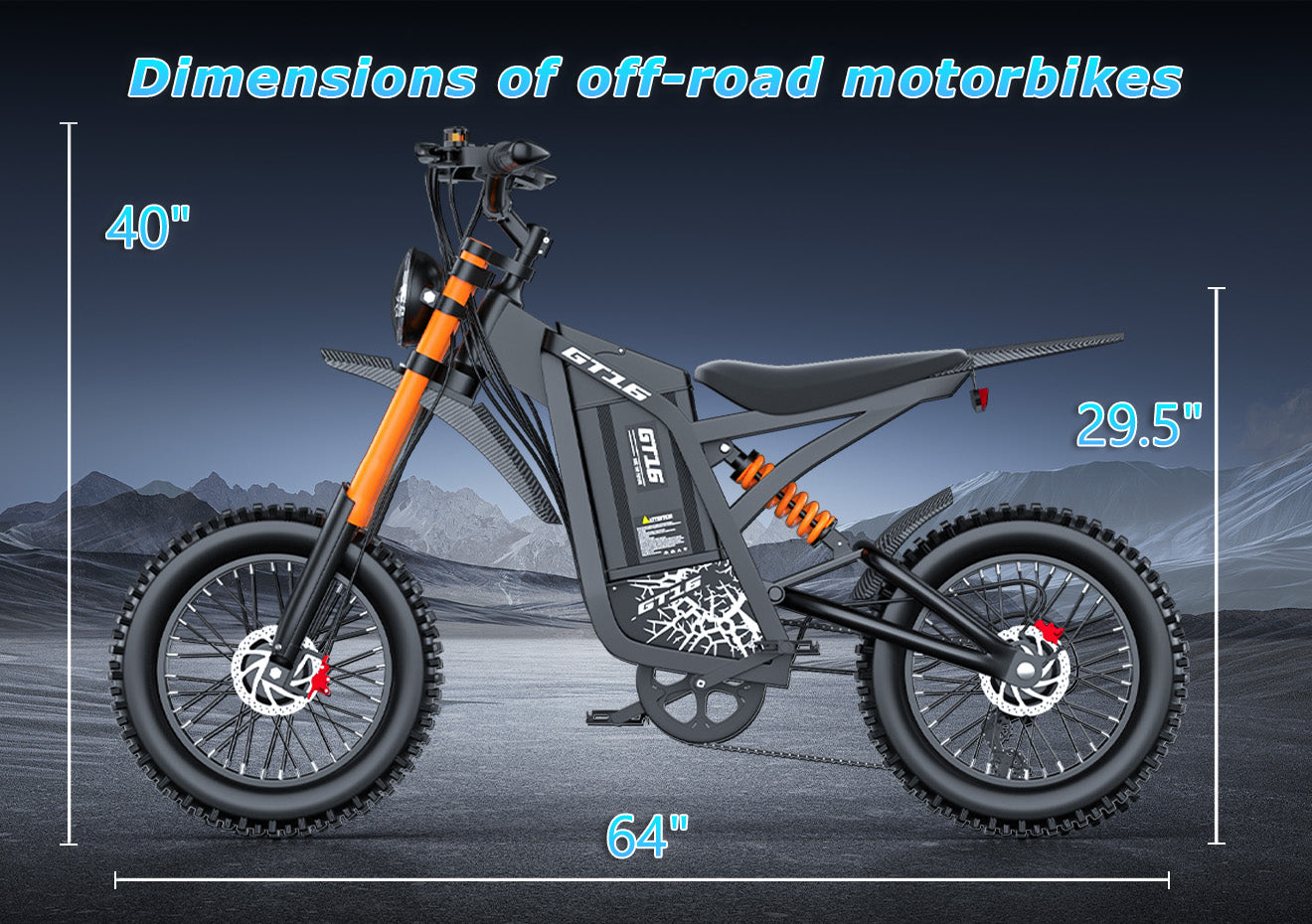
- PostJoy GT16Plus ($899): 5500W peak motor, 60V 30Ah battery (1800Wh), dual hydraulic brakes, 16" off-road tires, full suspension. Fits 4'9" to 6', 99.2 lbs, up to 80 miles claimed range. Wider fit range and more battery capacity than the GT50.
- Other brands in this range: $2,500-$4,500 for established names with longer track records and dealer networks.
At this tier, you're paying for durability and usability, not peak performance. The bike should handle regular trail riding without constant repairs or component failures.
$5,000-$8,000: High-Performance Trail and Enduro Models
Who this fits: Experienced riders, frequent trail riding, some technical terrain, riders who want a bike that won't limit their skill progression.
Worth paying for if:
- You ride 2+ times per week
- You hit technical trails (roots, rocks, steep grades, tight turns)
- You've outgrown entry-level bikes and know what you need
- You want adjustable suspension you can tune for your weight and terrain
- You need extended range (60+ real-world miles, not marketing claims)
What the extra money buys:
- Better thermal management (sustained power without overheating)
- Higher-quality suspension (adjustable compression, rebound, preload)
- Refined power delivery (smooth engagement, less jerky response)
- Stronger frame and components (handle abuse without bending or breaking)
- Dealer service network (can get parts, labor, and support locally)
Common examples: Sur-Ron, Segway, Talaria, and other established e-moto brands. Expect $5,500-$7,500 for trail-ready models with proven reliability.
Not necessary if: You ride once or twice a month, stick to easy terrain, or you're still learning fundamentals. A mid-range bike will serve you better than an expensive bike you're intimidated by.
$8,000 and Up: Premium and Competition E-Motos
Who this needs: Racers, expert riders, people who ride technical terrain frequently and push bikes to their limits.
What competition-level hardware buys:
- Race-tuned suspension (full adjustability, high-end dampers)
- Maximum power output with thermal management for sustained performance
- Lightweight materials (carbon, titanium, magnesium components)
- Advanced electronics (traction control, ride modes, data logging)
- Competition warranty and race support
You don't need this if:
- You're not racing or riding at near-race pace
- You ride for fun, fitness, or casual trail exploration
- You're still learning bike control and progression
- You're not sure you'll stick with the sport long-term
Example pricing: $8,000-$12,000+ for brands like KTM, Stark, Alta (if still available). These bikes are built for riders who already know exactly what they need and why.
Don't buy on aspiration. If you're not sure whether you need race components, you don't.
What Makes One Electric Dirt Bike Cost More?
Peak wattage and claimed range are terrible ways to judge value. A 5000W motor can be smooth and controllable or jerky and unridable depending on the controller tune. An 80-mile range claim can mean 50 real-world miles or 30 depending on battery quality, rider weight, terrain, and temperature. Here's what actually matters.
| Cost Driver | Practical Benefit | Who Needs It | What to Verify |
|---|---|---|---|
| Battery capacity and voltage | Longer range, more power reserve, better hill climbing | Anyone riding 20+ miles per session or hilly terrain | Actual watt-hours (Wh), not just voltage and amp-hours separately. Ask for real-world range data. |
| Motor and controller quality | Smooth power delivery, less heat, predictable response | Everyone, but critical for trail riding | Rated vs peak power, thermal protection, controller tune quality. Test ride if possible. |
| Suspension | Absorbs hits, maintains traction, reduces fatigue | Trail riders, anyone on rough terrain | Adjustable or basic? Rebuildable or sealed? Can you get replacement seals and oil? |
| Brakes and wheels | Stopping power, control, durability | Everyone, non-negotiable for safety | Hydraulic vs mechanical, rotor size, lever reach adjustment, tire quality and tread depth. |
| Frame and build quality | Durability, crash resistance, component longevity | Frequent riders, anyone pushing limits | Welds, paint quality, bearing quality, how components are mounted (bolted or riveted). |
| Warranty and parts support | Can you fix it when it breaks? | Everyone, but critical for new brands | Warranty length, what it covers, parts availability, local service options, battery replacement cost and lead time. |
I'd rather have a 3000W bike with a smooth controller and good brakes than a 6000W bike with instant, uncontrolled power and marginal stopping. The specs that look impressive on paper aren't always the ones that matter when you're riding.
The Out-the-Door Cost Beyond the Bike
The advertised price is just the start. Here's what actually separates you from riding.
| Expense | When It Applies | Typical Cost | How to Verify |
|---|---|---|---|
| Sales tax | Most US states | 6-10% of purchase price | Check your state and local rate |
| Shipping/freight | Online purchases | $100-$400 depending on distance and bike weight | Ask before checkout; some brands include it |
| Assembly | Most bikes ship 80-95% assembled | $0-$150 if you pay someone | Check what's required; some dealers offer free assembly |
| Dealer/doc fees | Buying through a dealer | $100-$500 | Negotiable in some cases |
| Registration/OHV permit | Depends on state and where you ride | $25-$150/year | Check your state's OHV requirements and whether your riding area requires it |
| Helmet and riding gear | Everyone, non-negotiable | $200-$600 minimum | DOT helmet, gloves, boots, goggles. Don't skip this. |
| Lock or storage | If you can't store it inside | $50-$200 | Quality lock for outdoor storage, or secure indoor space |
| Hitch carrier or trailer | If you don't have a truck | $200-$800 for carrier, $800+ for trailer | Check your vehicle's hitch rating and bike weight |
| Initial setup/spare parts | Smart to have on hand | $50-$150 | Spare tubes, tire repair kit, basic tools, chain lube |
Example out-the-door calculation:
- PostJoy GT50: $699
- Sales tax (8%): $56
- Shipping: $0 (included)
- Helmet and gear: $250
- Hitch carrier: $300
- Initial supplies: $75
- Total out-the-door: $1,380
This is why a $700 bike can easily become a $1,400-$1,500 investment before you ride it once. Budget for the whole picture, not just the bike price.
For legal requirements by state and riding location, see the electric dirt bike legal guide.
What Does an Electric Dirt Bike Cost to Own Each Year?
Charging Electricity
Formula: Battery capacity (kWh) × local electricity rate ($/kWh) × number of full-charge cycles per year
Worked example:
- PostJoy GT50: 48V 25Ah = 1.2 kWh (1200Wh)
- National average electricity rate: $0.14/kWh (U.S. Energy Information Administration, July 2026. Check your local rate; prices vary by region and provider.)
- Riding once per week, 50 charges per year
- Annual cost: 1.2 kWh × $0.14 × 50 = $8.40
Even if you ride twice a week, you're looking at $15-20 per year in electricity. Charging is cheap. It's everything else that adds up.
Note: Wall energy will be slightly higher than battery capacity because charging isn't 100% efficient. Add 10-15% to account for charging losses.
Routine Maintenance and Wear Parts
Electric dirt bikes skip oil changes, air filters, spark plugs, and clutch maintenance, but they're not maintenance-free.
Annual or as-needed:
- Tires: $60-$150 depending on quality and how fast you wear them
- Brake pads: $20-$40 per set, replace when worn
- Chain and sprockets (if equipped): $50-$100 per year for frequent riders
- Brake fluid flush (hydraulic brakes): $20-$40 every 1-2 years
- Suspension service: $100-$200 every 1-2 years if you ride hard
- Bearings: $30-$80 as needed (wheel bearings, headset, swing arm)
If you do your own work: $100-$300 per year for parts (based on rider reports and shop quotes for typical wear items)
If you pay a shop: Add $50-$100 per hour labor, figure $200-$500 per year depending on how much you ride and how hard you push the bike.
Lighter riders on smoother terrain will spend less. Heavier riders on rough trails will spend more.
Battery Replacement and Long-Term Capacity Loss
This is the big unknown. Battery packs degrade over time and use, but replacement cost, availability, and timing vary wildly by brand and model.
What affects battery life:
- Charge cycles (300-1000+ depending on quality and how you charge)
- Storage temperature (heat kills batteries faster than cold)
- Depth of discharge (draining to 0% repeatedly shortens life)
- Charging habits (frequent fast charging vs slow overnight charging)
Replacement cost range: $300-$1,200+ depending on capacity, voltage, and brand. Some brands don't sell replacement packs to consumers at all.
What to do before you buy:
- Ask the manufacturer or dealer for the exact replacement battery part number and current price
- Confirm the battery is available for purchase (not just "contact us for pricing")
- Check the warranty: what percentage of capacity loss is covered, and for how long?
- Factor $400-$800 into your long-term ownership budget if you plan to keep the bike 3-5+ years
PostJoy batteries are removable, which makes replacement simpler than bikes with integrated packs. Confirm replacement pricing and availability for any bike you're considering.
Gear, Transport, Permits, and Storage
One-time costs:
- Protective gear: $200-$600 (helmet, gloves, boots, goggles, body armor if needed)
- Transport: $200-$800 (hitch carrier or trailer)
Recurring costs:
- OHV permits or registration: $25-$150/year depending on location
- Gear replacement: $50-$150/year (gloves wear out, helmets need replacing after crashes or every 5 years)
- Storage: $0 if you have space, $50-$150/month if you need to rent
Plan for at least $100-$200 per year in recurring costs beyond the bike itself.
Three-Year Total Cost of Ownership Worksheet
Here's a reusable calculation. Plug in your own numbers based on how you actually ride.
Formula:
Purchase price + out-the-door costs + (electricity × 3 years) + (maintenance × 3 years) + gear replacement + permits/registration × 3 years + transport + expected battery allowance - estimated resale value = Three-year total cost
Scenario 1: Low-Use Recreational Rider
Profile: Rides once or twice a month, mostly smooth terrain, casual use.
- Purchase: $699 (GT50)
- Out-the-door adds: $350 (tax, shipping, initial setup)
- Electricity: $10/year × 3 = $30
- Maintenance: $150/year × 3 = $450
- Gear replacement: $100 over 3 years
- Permits: $50/year × 3 = $150
- Transport: $300 (one-time hitch carrier)
- Battery allowance: $0 (likely still good at 3 years with light use)
- Resale value: -$400 (estimated)
- Three-year total: $1,679
- Annual average: $560
Scenario 2: Regular Trail Rider
Profile: Rides weekly, mix of terrain, moderate wear on components.
- Purchase: $899 (GT16Plus)
- Out-the-door adds: $450 (tax, shipping, gear)
- Electricity: $20/year × 3 = $60
- Maintenance: $300/year × 3 = $900
- Gear replacement: $200 over 3 years
- Permits: $75/year × 3 = $225
- Transport: $400 (hitch carrier)
- Battery allowance: $400 (capacity may drop, plan for replacement)
- Resale value: -$500 (estimated)
- Three-year total: $3,034
- Annual average: $1,011
Scenario 3: High-Use Enthusiast
Profile: Rides 2-3 times per week, technical terrain, hard on components.
- Purchase: $4,500 (mid-range established brand)
- Out-the-door adds: $800 (tax, shipping, dealer fees, gear)
- Electricity: $40/year × 3 = $120
- Maintenance: $500/year × 3 = $1,500
- Gear replacement: $300 over 3 years
- Permits: $100/year × 3 = $300
- Transport: $600 (quality carrier or trailer)
- Battery allowance: $800 (likely needs replacement by year 3)
- Resale value: -$2,000 (estimated)
- Three-year total: $6,920
- Annual average: $2,307
Your assumptions matter. These are examples, not promises. Your electricity rate, maintenance costs, riding frequency, and battery life will differ. Use this framework and plug in your own numbers.
Your Three-Year TCO Calculation
Use this blank worksheet to calculate your own costs:
Purchase price: $______
Out-the-door adds: $______
Electricity (___/year × 3): $______
Maintenance (___/year × 3): $______
Gear replacement: $______
Permits (___/year × 3): $______
Transport: $______
Battery allowance: $______
Estimated resale: -$______
= Three-year total: $______
Annual average: $______ ÷ 3
Electric vs Gas Dirt Bike Cost
| Cost Category | Electric | Gas |
|---|---|---|
| Purchase price | $700-$12,000+ | $1,500-$12,000+ |
| Energy/fuel | $10-$40/year (electricity) | $200-$600/year (gas, oil) |
| Routine maintenance | $100-$500/year (tires, brakes, chain, bearings) | $300-$800/year (oil, filters, spark plugs, air filter, valves, clutch, plus tires/brakes/chain) |
| Major service | Battery replacement ($400-$1,200, years 3-5+) | Top-end rebuild ($500-$1,500, varies by use) |
| Refueling/charging time | 4-8 hours (wall outlet) | 2-5 minutes (gas station) |
| Noise | Nearly silent | Loud (may limit where you can ride) |
| Resale uncertainty | Battery condition hard to verify, fewer buyers | Established market, easier to sell |
Electric saves money on fuel and routine maintenance, but that battery replacement is a real expense. Whether you save money over 3-5 years depends on how much you ride, local electricity and gas prices, whether you do your own work, and how long the battery lasts.
Gas bikes have predictable maintenance schedules. Electric bikes trade oil changes and clutch work for battery anxiety and charging time.
For battery charging safety, follow manufacturer guidelines and NFPA (National Fire Protection Association) lithium battery charging recommendations. Never leave batteries charging unattended on flammable surfaces.
For a full performance and experience comparison, see the electric vs gas dirt bike guide.
Are Cheap or Used Electric Dirt Bikes Worth It?
Cheap new bikes and used bikes both carry risk. Here's what to check before you buy.
Red Flags (Walk Away)
- Swollen, damaged, or leaking battery pack
- Mismatched charger (wrong voltage, wrong connector, aftermarket)
- Altered wiring, bypassed safety features, or opened battery case
- Missing serial number or title (if required in your state)
- Unavailable critical replacement parts (battery, controller, motor)
- Seller can't or won't provide charge history, crash history, or maintenance records
Yellow Flags (Investigate or Negotiate)
- Battery age over 2 years with unknown charge cycles
- No warranty or no warranty transfer
- Frame damage (bent subframe, cracked welds, previous crash evidence)
- Worn brakes, fork seals leaking, loose bearings
- Corroded connectors, water intrusion evidence, stored outdoors
- Error codes or warning lights that seller dismisses as "normal"
Green Lights (Probably Safe)
- Battery diagnostic data showing good health (if available)
- Correct OEM charger included
- Low use, proper storage, maintenance records available
- Warranty transfers to new owner
- Frame and components in good condition
- All critical parts available and priced
- Clean title (if required), matching serial numbers
How to verify battery health without diagnostic data:
- Ask seller for charge-cycle history or battery purchase date
- Request a 15+ minute test ride under load (hills, acceleration, varied speeds)
- Watch for: sudden power drops, error codes, significant voltage sag, or inconsistent performance
- A healthy battery maintains consistent power throughout the ride without warning lights
- If seller refuses demo or won't answer battery questions, price in a $400-$800 replacement or walk away
Used electric dirt bikes are risky if you can't verify battery condition. Unlike a gas bike where you can compression test the engine, battery health is mostly invisible until it fails. If the seller won't provide charge-cycle data or let you test the battery under load, price that uncertainty into your offer or walk away.
Cheap new bikes (under $800) from unknown brands: You're gambling on parts support and longevity. If the company disappears or the battery fails in year two, you might own an expensive paperweight. Stick with brands that have been around for at least 2-3 years and have active customer support.
How to Set the Right Electric Dirt Bike Budget
Step 1: Start with Fit and Use Case
Before you look at prices, answer:
- Can I physically fit the bike? (Run the fit check: seat height, reach, standing posture, bike recovery)
- Where will I ride it? (Private property, OHV park, technical trails, backyard practice)
- How often? (Once a month, weekly, multiple times per week)
- What skill level am I now, and where do I expect to be in 6-12 months?
Price follows fit and use. Don't shop by budget first.
Step 2: Set Your Component Minimums
Based on your use case, what's non-negotiable?
- Hydraulic brakes (both wheels, or just one okay for now)?
- Suspension quality (basic is fine, or do you need adjustable)?
- Range requirement (30 real-world miles enough, or do you need 50+)?
- Parts support (can you get tires, brake pads, battery packs)?
Write these down before you start comparing bikes.
Step 3: Calculate True Out-the-Door Cost
Add:
- Bike price
- Sales tax
- Shipping (if not included)
- Assembly (if you'll pay someone)
- Helmet and protective gear (if you don't have it)
- Transport solution (carrier, trailer, or do you have a truck?)
- First-year permit/registration (if required)
That's your real entry cost. If it's more than you have, you're not ready yet. Skipping the helmet or carrier to make budget is backward.
Step 4: Reserve Funds for Ownership
Can you handle $100-$300 per year in maintenance and wear parts? If not, you'll stop riding when the first tire wears out or the brake pads need replacing.
Step 5: Compare Only Bikes That Meet Your Minimums
Now you can shop. Score bikes that fit, meet your component minimums, and fit your ownership budget. Ignore everything else.
If no bike meets your requirements at your budget, save longer or adjust your expectations. Don't buy a bike that doesn't fit or lacks critical features just because it's cheap.
For a complete selection framework, see the electric dirt bike buying guide.
Electric Dirt Bike Cost FAQs
How much does a good electric dirt bike cost?
For adult trail riding, expect to spend $2,000-$5,000 for a capable bike from an established or emerging brand with real components. You can find entry-level options under $1,500 (like the PostJoy GT50 at $699) that offer surprisingly solid specs, but you're accepting a newer brand with less track record. Over $5,000 gets you premium components and refinement that most recreational riders won't fully use. Price reviewed: August 2026.
How much does it cost to charge an electric dirt bike?
Use this formula: battery capacity in kWh × your local electricity rate × charge frequency. For example, a 1.2 kWh battery (48V 25Ah) at $0.14/kWh costs $0.17 per full charge. If you ride weekly and charge 50 times per year, that's about $8.50 annually. Even heavy users spend $20-40 per year on electricity. Charging is cheap. It's the gear, maintenance, and transport that add up.
How much does an electric dirt bike battery cost to replace?
Replacement battery packs run $300-$1,200+ depending on capacity, voltage, and brand. Some manufacturers don't sell packs directly to consumers. Before you buy any electric dirt bike, ask for the exact replacement battery part number, current price, and availability. Factor $400-$800 into your long-term ownership budget if you plan to keep the bike 3-5+ years. Shipping for lithium-ion batteries can add $50-$150 depending on carrier restrictions.
Are electric dirt bikes cheaper to maintain than gas dirt bikes?
For routine maintenance, yes. You skip oil changes, air filters, spark plugs, clutch work, and valve adjustments. Electric bikes need tires, brakes, chain, and bearings just like gas bikes, but you save $150-$300 per year on engine maintenance. The catch: battery replacement ($400-$1,200) eventually hits, while gas bikes need top-end rebuilds ($500-$1,500) depending on use. Over 3-5 years, electric can be cheaper if you ride regularly and do your own work, but it's not automatic savings.
Is it better to buy a cheap new bike or a used premium bike?
Buy the cheap new bike if it meets your minimums, you can verify parts support, and it comes with a warranty. Buy the used premium bike only if the battery health is verified, the seller provides maintenance records, critical parts are available, and the price reflects the battery's remaining life. Used electric bikes are riskier than used gas bikes because battery condition is hard to verify. If you can't test the battery under load or get charge-cycle data, price in a replacement battery ($400-$800) when making your offer.
Compare Electric Dirt Bikes by Real Cost, Not Just Price
Run the out-the-door calculation. Add three years of ownership costs. Then decide.
The PostJoy GT50 and GT16Plus both offer mid-range features at entry-level prices, but they're newer to the market with less long-term reliability data than established brands. If you're willing to take that risk for significant savings, they're worth considering. If you want a proven track record and dealer network, expect to pay $2,500-$5,000+ for brands with 5-10+ years in the market.
Compare electric dirt bikes after you've set your budget, confirmed your fit, and calculated your true ownership cost.
Share:
Eco-Friendly E-Bikes: A Practical Guide to Greener Commutes
Electric Dirt Bike Maintenance: The Complete Owner's Guide