
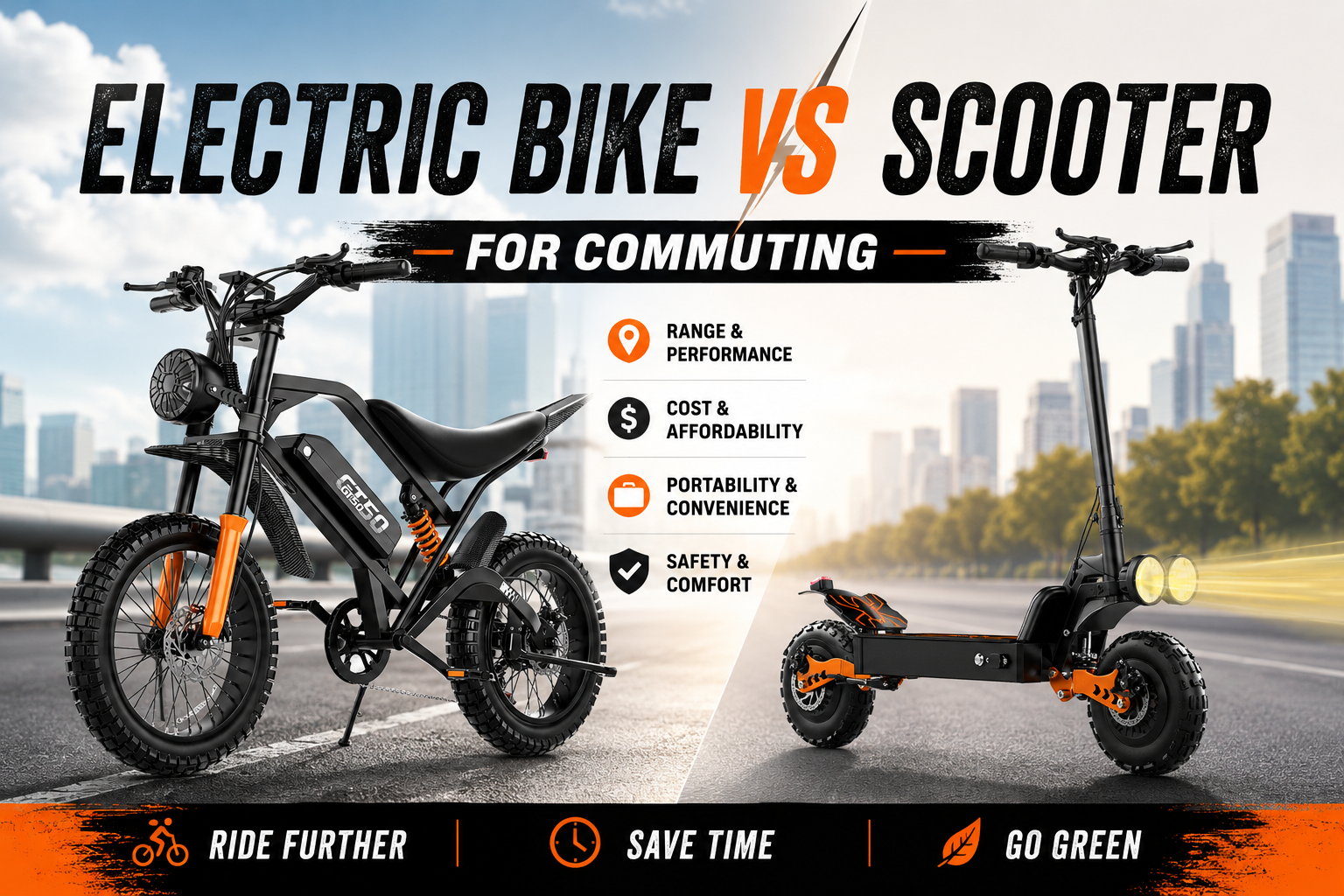
Commuters have more options than ever for getting to work. No longer does it mean being stuck on public transport or spending a small fortune on fuel and parking costs. Both electric bikes and scooters let you skip the congestion, reduce costs, and minimize your emissions.
But which is better for commuting?
 Electric bikes and scooters can save money and time. Despite their similarities, however, they’re very different forms of transport. Factors like commute length, terrain, storage, weather, and local regulations can dramatically influence which is the better option.
Electric Bikes and Electric Scooters Explained
What is an Electric Bike?
An electric bike is essentially a normal push-bike with an electric motor that assists while pedaling. There are throttle options. Generally, however, electric bikes are designed for typical commuting speeds (20 to 28mph).
Most commuter electric bikes have a range between 50 and 80 miles, depending on battery size. That’s enough for most commutes — although the battery can drain quicker at faster speeds or with heavier loads.
What is an Electric Scooter?
An electric scooter is very different. It involves standing on a flat platform with a handlebar-controlled electric motor. There are no pedaling or high-powered motors. Instead, it’s designed for lower speeds within a city center.
They’re extremely popular in city centers due to their foldable, portable design. It’s easy to carry an electric scooter onto public transport, and you can even ride them along pavements, giving you greater accessibility. They prioritize convenience and portability over comfort and versatility.
Electric Bike vs Scooter at a Glance
|
Feature |
Electric Bike |
Electric Scooter |
|
Average Range |
20–80+ miles depending on battery size and assist level |
10–40 miles, depending on battery size and model |
|
Comfort |
Seated position, larger wheels, and optional suspension make longer rides more comfortable |
Standing position and smaller wheels can become tiring on longer journeys |
|
Portability |
Larger and heavier; requires dedicated storage space |
Compact, foldable, and easy to carry onto public transport |
|
Hill Climbing |
Excellent, especially with mid-drive motors and pedal assistance |
Adequate on gentle inclines, but performance can drop on steeper hills |
|
Safety & Stability |
Larger wheels provide better stability, braking, and handling on uneven roads |
Smaller wheels are more affected by potholes, bumps, and poor road surfaces |
|
Best For |
Longer commutes, hilly routes, comfort-focused riders, and mixed recreational use |
Short urban commutes, first-mile/last-mile travel, and commuters needing maximum portability. |
If a scooter is the better format for your trip, the guide to the best commuter electric scooters explains what to prioritize next.
Which is Faster for Commuting?
In a straight race, e-bikes will always come out on top. There are very few electric scooters that hit 28mph. But real life is rarely a straight race. There are traffic lights, dense traffic, hills, pedestrian areas, and other factors.
Electric bikes generally win out over longer commutes or difficult terrain. If you’re riding over hills or over a 10-mile commute, the bike is the better option. It has a faster top speed, better efficiency on hills, and you can keep pedaling if the battery is low.
Electric scooters, on the other hand, win out in dense urban environments. They have strong acceleration from traffic lights and can cut through pedestrian areas, shortening journeys. If your commute is 2 miles within the city center, they’re probably better than an e-bike.
Range and Battery Life Compared
Electric bike wins hands down on range and battery life. It’s not a competition electric scooters are trying to win.
Due to the size of an e-bike, they can store bigger batteries, allowing them to last for much longer (and reach higher top speeds).
Here’s the difference:
- Electric bikes: 25–50 miles average range.
Scooter buyers can use the real-world range guide to estimate how far a specific battery will travel under normal conditions.
- Electric scooters: 15–30 miles average range.
This matters more than you’d think. The more you need to recharge a battery, the less time it will last. Electric bikes can last anywhere from 3 to 7 years (500-1,000+ charge cycles), whereas an electric scooter only has 2 to 4 years (300-1,000 charge cycles). During that time, users will begin to notice a fall in performance.
Comfort and Ride Quality
Once again, electric bikes are better.
The seated riding position, larger wheels, suspension system, and ergonomic handlebars are all designed to reduce rider fatigue. The bike is, after all, a long-distance vehicle. It’s intended for people to spend hours in the saddle, even on rough roads.
Electric scooters, by contrast, require riders to stand, increasing pressure on knees and feet. The smaller wheels also transmit more road vibration into your body, especially impacts from potholes and rough surfaces.
 That said, the PostJoy Foldable Electric Scooter actually does come with a seat. It also has slightly bigger (14”) tires and a front and rear suspension. Compared to most electric scooters, it’s a lot comfier, capable of handling potholes and bumpy roads with relative ease.
Portability and Storage
Electric scooters come out on top.
With a simple hinge mechanism, the entire scooter can fold up into a compact package. It’s small enough that you can easily carry it into offices, upstairs, or onto trains and buses. You could even slip it under your desk.
E-bikes aren’t quite as hard to carry as you’d think.
Foldable e-bikes can offer commuters the chance to carry their bike onto public transport or upstairs. However, the portability means sacrificing many of the benefits that make e-bikes better. At that point, you may as well opt for the scooter.
Safety Considerations
Electric bikes have larger wheels, better stability, and more predictable handling. They’re generally considered safer. But as before, it comes down to when they’re intended to be used.
Electric scooters also come in all shapes and sizes. While the lightweight scooters you often see zipping around cities are quite fragile, offering riders little stability, the PostJoy K10 has much thicker wheels and greater visibility. It’s more akin to many foldable e-bikes. New riders should review how to ride an electric scooter safely before entering traffic or shared paths.
And that’s the part most people don’t talk about. They compare a sturdy commuter bike to an electric scooter. But foldable e-bikes — a common choice for many commuters — are much less stable and can struggle with wet roads, gravel, uneven pavements, and icy conditions just the same as any scooter.
Costs and Running Expenses
Both electric bikes and electric scooters are remarkably inexpensive to run, especially when compared to the cost of driving. Charging either vehicle typically costs just a few cents, with most riders spending less than $50 per year on electricity.
Electric bikes
- Typical purchase price: $1,000–$4,000+
Our electric scooter buying guide shows how to balance price against battery quality, brakes, tires, warranty, and practical use.
- Annual electricity cost: around $20–$50
- Battery replacement: $400–$1,200+
- Generally offer greater range, comfort, and versatility
Electric scooters
- Typical purchase price: $400–$2,000+
- Annual electricity cost: around $10–$40
- Battery replacement: $200–$800+
- Usually the cheaper option to buy and maintain
While electric bikes offer advantages in comfort and range, electric scooters are often the more practical choice for urban commuters. They're cheaper to buy, easier to store, and simpler to carry onto public transport or into an office.
For shorter daily journeys, many riders find that a scooter delivers everything they need while keeping both upfront and ongoing costs to a minimum.
Electric Bike vs Scooter for Different Types of Commuters
Comparing electric bikes and scooters for commuters isn’t really fair. They’re designed for different kinds of commuters.
Electric scooters are best for short-to-medium urban commuters. Riders choosing between PostJoy scooter models can use the K10 vs GT28 comparison. Think 1-10 miles. They offer speed, convenience, and storage. If you’re willing to upgrade to a scooter like the K10, you even get a bit of extra power and comfort — perfect for tackling urban streets.
However, if your commute goes over 10 miles, an e-bike becomes more and more attractive. Rider fatigue, greater stability, and a lower risk of needing to recharge provide a better riding experience. They’re also better able to tackle hilly areas due to stronger motor power and torque.
The real question is for mixed-use journeys. Many people find a foldable e-bike a good option. However, some models are still heavy and difficult to carry. Electric scooters don’t have this problem. They’re built to be lightweight and work in urban environments.
Ultimately, there’s no universal winner. It depends on your commute.
FAQs
Is an electric bike or scooter better for commuting?
It depends on your journey. Electric bikes are generally better for longer commutes, hilly routes, and riders who prioritize comfort. Electric scooters are often better suited to shorter urban commutes where portability and storage are important.
Are electric scooters cheaper to run than electric bikes?
Yes. Electric scooters typically cost less to purchase, charge, and maintain. They also tend to have lower battery replacement costs, making them one of the most affordable forms of motorized transport.
Which has a longer range: an electric bike or scooter?
Electric bikes typically have more range. Most commuter e-bikes can last for up to 50 miles on a single charge. Electric scooters typically achieve between 15 and 30 miles under real-world conditions.
Can I take an electric bike or scooter on public transport?
Technically, yes. However, practically carrying an electric bike (even a foldable version) onto public transport presents a lot of problems. Many people find it easier to carry an electric scooter as they fold into a compact size and are lightweight.
Share:
Electric Dirt Bike Maintenance: The Complete Owner's Guide
Do You Need a License for an Electric Dirt Bike?